COST OPTIMIZATION

 Table of ContentsExecutive Summary
01 · OPTIMIZE USER LICENSING
100 Oracle NetSuite users don't necessarily need 100 Full Licensed Users. Employee Center, View & Approve, WMS and other Specialized User types can cover different usage needs at a significantly lower cost. Right-sizing licenses can save tens of thousands of USD a year.
02 · OPTIMIZE TRANSACTION LIMITS
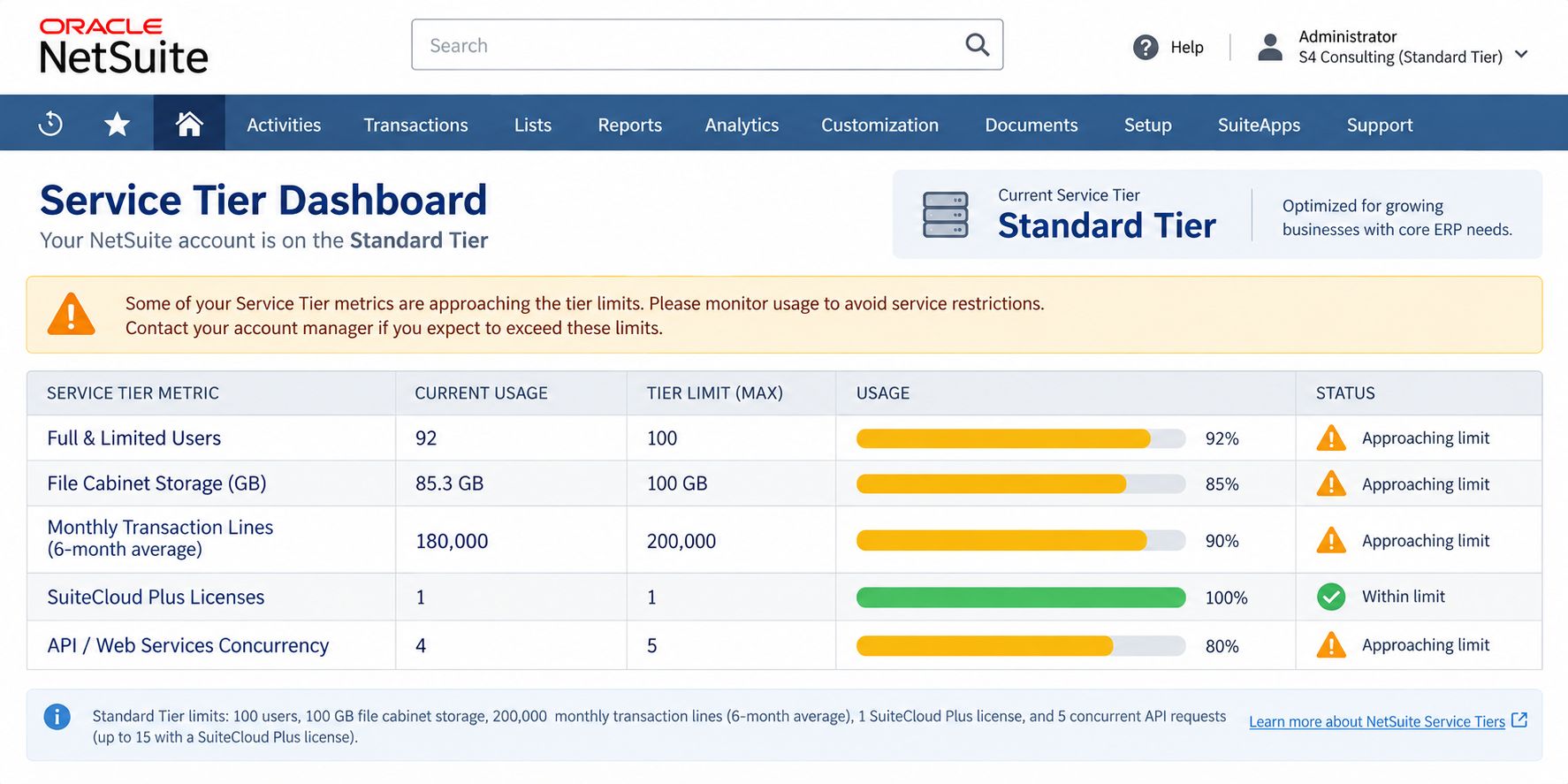
The Standard tier caps out at 200K Transaction Lines/month. If a business is forced to upgrade to a higher infrastructure tier, the cost can be equivalent to buying roughly 40 additional users.
03 · OPTIMIZE HOW YOU USE ORACLE NETSUITE
If 200 employees only occasionally submit a purchase request, payment or travel expense, they don't necessarily need an Oracle NetSuite license. Using a satellite system such as S4 eSuite or Yooz can cut license costs by 20%-50%.
3 Key Points to Know
- Full User isn't the default choice for every employee. Oracle NetSuite offers multiple user license types with different pricing, permissions and use cases. Review each user group's actual needs before purchasing more Full Licensed Users.
- Monthly Transaction Line volume depends heavily on how the system is designed - the level of detail in documents posted to the General Ledger, the number of lines per document, and how the Production Costing Template is structured.
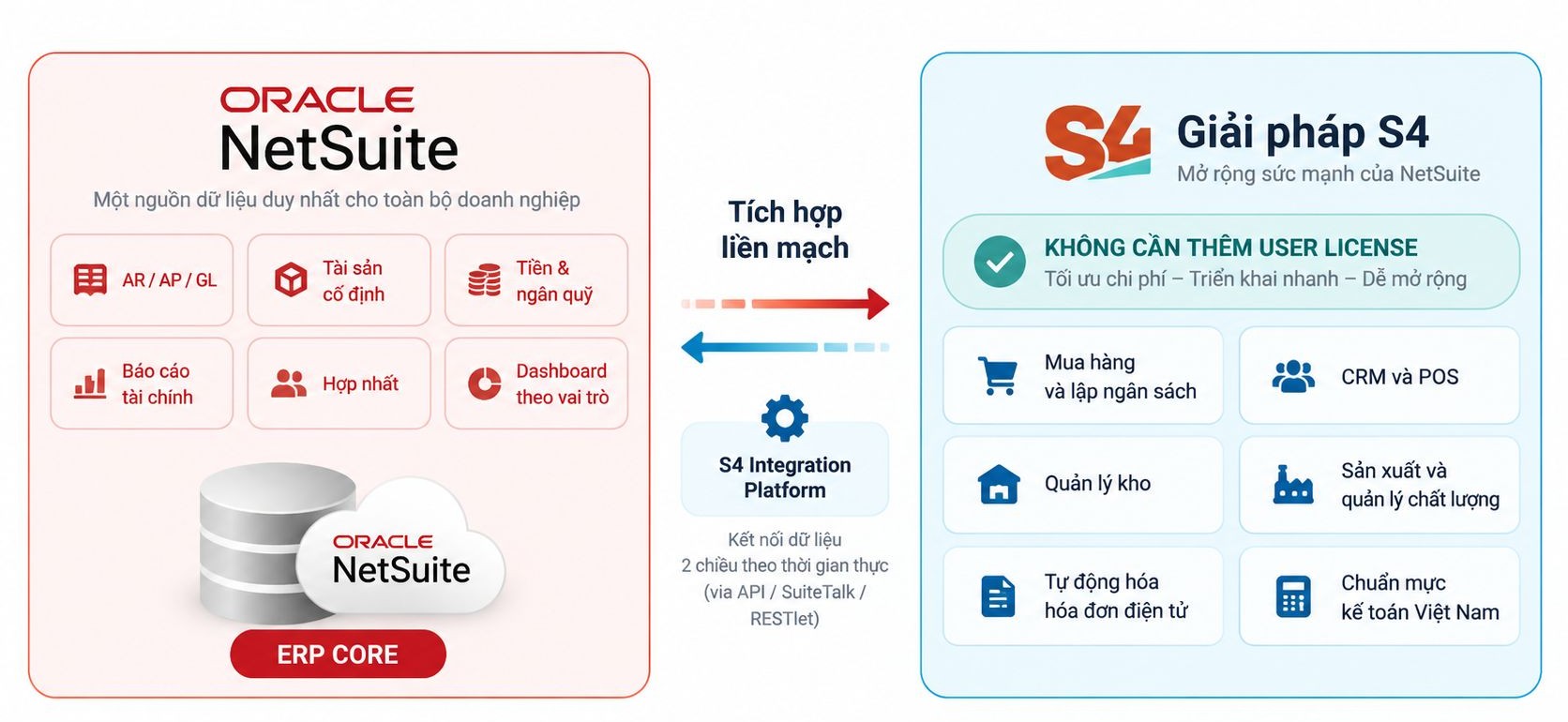
- All-in-one isn't necessarily the most economical option. As integration technology matures, running multiple systems around Oracle NetSuite is becoming common practice, significantly reducing user and ERP module license costs.
 Right User
| License / Access | Fits which need? | Vs. Full User | Difference |
|---|---|---|---|
| Full Licensed User | Finance, accounting, operations and power users needing broad ERP permissions | 100% | 20 |
| Employee Center / Employee Self-Service | Time, expense, self-service and limited employee tasks | ≈16.5% | 30 |
| View & Approve | Managers who need to view and approve, but not transact | ≈25% | 10 |
| WMS / Specialized User | Warehouse or other role-specific specialized functions | ≈82.5% | ≈17.5% lower |
| MES / Specialized User | Specialized-function users with a narrow scope of activity | ≈20.8% | ≈79.2% lower |
Applying the Right User - Right Role - Right Access Principle
Right User
Grant direct access only to people who genuinely need to perform transactions in the ERP.
Right Role
Roles should reflect actual job functions and internal control principles, not setup convenience.
Right Access
A need to view data or approve something doesn't automatically mean a need for deep ERP access.
Service TierSales / Bill
High document volume and many lines per document can push Transaction Lines up quickly. Review how Sales Orders and Invoices/Bills are created, and how documents are split or consolidated.
Manufacturing
In Manufacturing, Cost Template structure can generate many lines of data for a single production activity. This is a key area to check when Transaction Lines grow faster than work order volume.
Premium Tier list price can be equivalent to the cost of roughly 40 Full User licenses. This is why controlling Transaction Lines matters before the vendor requires a tier upgrade.
 Transaction Design
Merge Bills for Retail / E-commerce
Instead of posting every individual order from POS, website or marketplace channels into Oracle NetSuite through the full Sales Order → Item Fulfillment → Invoice → Payment chain, consolidate data by day or by sales channel and post it as a summarized transaction that fits the business.
- POS: each store can post a single consolidated Cash Sale after closing a shift or a day.
- E-commerce: consolidate orders by marketplace - Shopee, Lazada, TikTok Shop - by day to reduce document and line counts.
- Group lines by SKU category, tax rate, marketplace fees and promotions to preserve the financial detail you need.
- Use Location, Class, Department or Custom Segments to retain analytical detail without creating extra transaction lines.
Streamline Costing for Manufacturing
The more detailed a Cost Template, the more complex the data generated during production tends to become. A practical approach is to group Cost Categories into a few main cost buckets and move product-level differences into Routing, Run Time and Setup Time instead.
- Group Cost Categories into 3 main buckets: Material, Labor and Overhead.
- Use Routing to represent production stages instead of creating a separate Cost Category for every product.
- Handle minor and incidental costs through the Backflush mechanism at Assembly Completion instead of daily detailed entries.
- Deactivate old Cost Templates and Cost Categories, and standardize naming conventions to avoid unnecessary data proliferation.
Oracle NetSuite CoreWhen Should You Consider 2-Tier ERP?
- A large employee headcount, but a relatively small number who need core ERP access.
- A process with many users that doesn't require the full range of ERP functionality.
- Procurement or Expense processes more complex than standard self-service can handle.
- Multiple business units or subsidiaries, some with distinct operating needs.
- A desire to scale the system without a proportional increase in ERP Full Users.
- A need for a specialized solution built for one specific business capability.
 S4 eSuite
Value at the operational layer
Lets a business design high-participation processes without defaulting every participant into an ERP power user. This is especially worth considering for procurement requests, approvals and internal workflows.
Value at the ERP layer
Oracle NetSuite continues to serve as the center of gravity for accounting, financial control, consolidation and transactions that require data integrity. The two layers are connected, not separated.
Workflows Worth Evaluating First
- Workflows where the number of participants far exceeds the number of people who need deep Oracle NetSuite access.
- Workflows with clear logic that don't require the full ERP data model.
- A desire to extend digital workflows across the organization while keeping Oracle NetSuite as the financial core.
- A need for an operational layer suited to mobile use or non-ERP-specialist user groups.
 Appendix
| Term | Definition |
|---|---|
| Full Licensed User | A user with full ERP access, suited to finance, accounting, operations and power users. |
| Employee Center / ESS | Restricted access for self-service tasks - requests, time, expenses, travel expense claims. |
| View & Approve | View data and approve only, without transacting in the ERP. |
| WMS / MES Specialized User | A specialized user for warehouse or manufacturing functions, with a narrow scope of activity. |
| Transaction Lines | The number of data lines generated by transactions (Sales Order, Invoice, Work Order, etc.), used as the basis for determining Service Tier. |
| Service Tier (Standard / Premium) | Oracle NetSuite's infrastructure limit, based on monthly Transaction Lines and user count. |
| Digital Operations Layer | A satellite operational layer (such as S4 eSuite) that handles high-participation workflows without requiring a Full User ERP license. |
References
[2] SuiteSuccess.vn - "What Are Monthly Transaction Lines in NetSuite, and How Does Oracle Calculate Them", suitesuccess.vn/2026/01/18/....
[3] SuiteSuccess.vn - "NetSuite SuiteSuccess Experts in Vietnam: Role, Significance and the First Milestone", suitesuccess.vn/2025/11/11/....
[4] S4 Consulting - "Lac Pham, Vietnam's First NetSuite SuiteSuccess Expert", s4.com.vn/lac-pham-chuyen-gia-netsuite-suitesuccess-dau-tien-tai-viet-nam.
NEXT STEPReview User Licensing
Analyze users, roles and access needs to identify opportunities to reclassify licenses.
Analyze Transaction Line Volume
Determine monthly line volume, the sources generating the most lines, and how close you are to the 200,000-lines/month threshold.
Optimize How You Use Oracle NetSuite
Identify which workflows should stay in the core ERP and which are better suited to a Tier 2 layer such as S4 eSuite.
Build a Cost Plan
Compare current costs against the optimized model and quantify the potential savings.
The goal isn't to buy as little Oracle NetSuite as possible. The goal is to build a usage model with reasonable cost, room to scale, and a fit with how the business actually operates. When a workflow has many users but limited Oracle NetSuite needs, S4 eSuite can be evaluated as an additional operational layer.