



Upgrade Odoo or Replace It? When Should You Move?
What does upgrading Odoo mean, and when should a business consider replacing it?
Upgrading Odoo generally means moving an existing Odoo system to a newer version. However, for businesses that have used Odoo for several years, the more important question may be whether to continue upgrading Odoo or move to another Cloud ERP platform. The answer depends on customisation, maintenance costs, scalability, reporting requirements, integrations, and the company’s technology roadmap.
This is becoming a relevant question for Vietnamese businesses whose operations are growing faster than their existing ERP environment.
When does upgrading Odoo still make sense?
Upgrading Odoo can make sense when the existing system still supports core business processes effectively and the business does not face major architectural, data, or scalability limitations. If the company mainly uses standard modules, has limited customisation, and can control the upgrade effort, continuing with Odoo may avoid the disruption and cost of an ERP replacement project.
The situation changes when every upgrade requires substantial redevelopment, testing of custom code, data migration work, and technical resources. In that case, an “Odoo upgrade” may no longer be a simple version upgrade. The business should compare the cost of continuing with the existing platform against the cost of moving to a different Cloud ERP.
Upgrading Odoo to Cloud ERP:
3 Options Worth Considering
For businesses running Odoo and weighing the next step for their ERP.
Download the Free EbookWhat are the 5 signs that a business should evaluate replacing Odoo?
There are five signs that are particularly relevant when businesses review their ERP roadmap:
- Customisation and maintenance costs keep increasing. New business requirements increasingly require custom development instead of standard ERP functionality.
- The business is growing faster than the system. Transaction volumes, warehouses, branches, subsidiaries, or ERP users are increasing while the system is becoming a constraint.
- Management lacks real-time information. CFOs and management teams still depend heavily on Excel or manually processed reports to consolidate financial and operational data.
- The ERP requires too many separate integrations. The system needs to connect with e-commerce, sales, warehouse, CRM, or internal applications, creating an increasingly complex integration environment.
- Actual TCO is significantly higher than the original budget. The real cost includes infrastructure, technical resources, customisation, upgrades, integrations, maintenance, and issue resolution – not simply the software cost.
When several of these conditions occur at the same time, it is worth comparing the cost of continuing with Odoo against the cost of moving to Cloud ERP, rather than looking only at the price of the next upgrade.
How is Odoo On-Premise different from Cloud ERP?
The major difference is how the system is deployed and operated. With Odoo On-Premise, the business has greater control over its infrastructure and customisation environment, but it also carries more responsibility for infrastructure, maintenance, upgrades, security, and technical operations.
With Cloud ERP, more of the platform infrastructure and technical operation is handled by the provider. The business can focus more on business processes, data, reporting, and operational outcomes instead of maintaining the underlying technology stack.
When comparing the two approaches, CIOs and CFOs should consider at least these factors:
| Criteria | Odoo On-Premise | Cloud ERP |
|---|---|---|
| Infrastructure | Managed by the business | Managed largely by provider |
| Upgrades | Planned and tested internally | Follow platform roadmap |
| Customisation | Highly flexible | Depends on platform architecture |
| Scalability | Requires infrastructure assessment | Generally easier to scale |
| Management data | Depends on system design | Centralised Cloud data model |
| Cost model | Includes multiple operating costs | Requires subscription + services TCO |
Neither model is automatically suitable for every business. The more useful approach is to calculate 5-7 year TCO rather than comparing only the first-year software cost.
Is Acumatica worth evaluating as an alternative to Odoo?
Acumatica is one of the platforms that businesses can include in a Cloud ERP shortlist when evaluating a move away from their existing ERP. In the Nucleus Research SMB ERP Technology Value Matrix 2026, Acumatica is classified as a Leader.
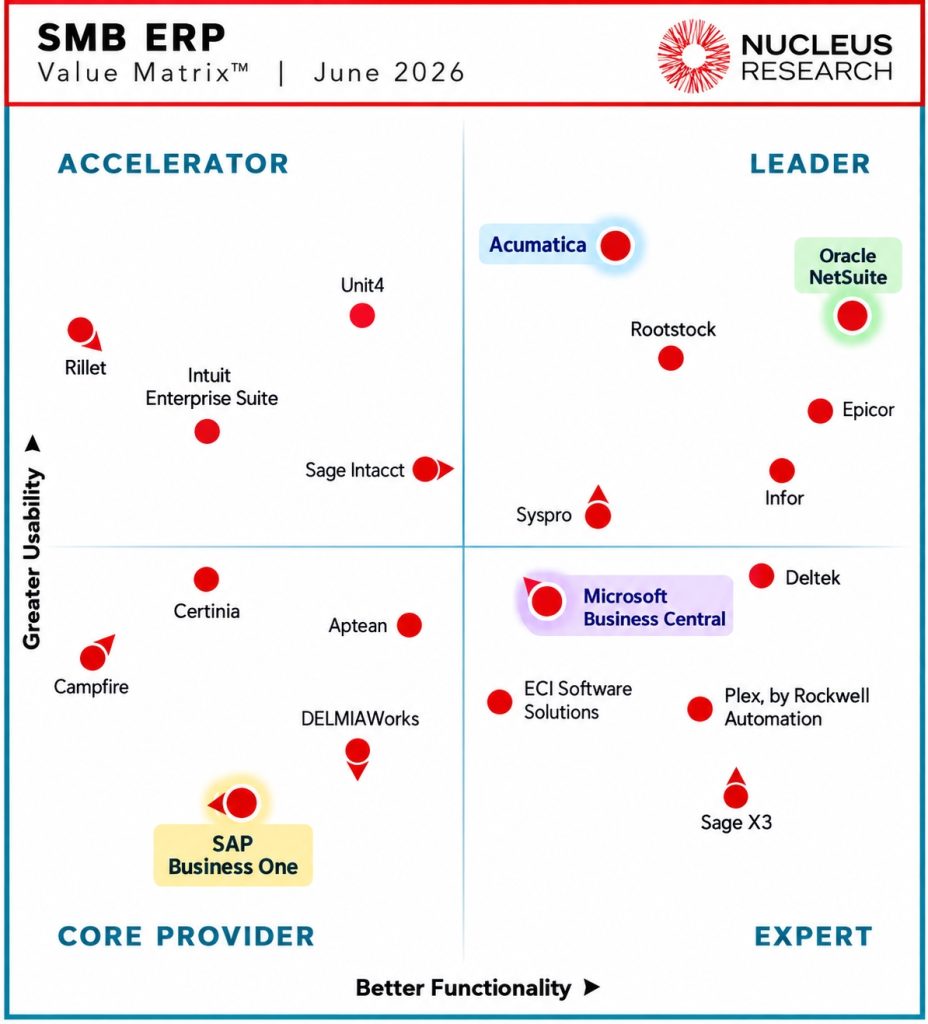
One notable difference is Acumatica’s consumption-based licensing model. It allows unlimited users while scaling based on transaction and resource consumption rather than employee or user count. For businesses with many employees who need access to ERP, this is an important factor to include in the TCO analysis.
Acumatica also supports areas such as manufacturing, distribution, construction, retail, e-commerce, and professional services. Businesses moving from Odoo should therefore evaluate Acumatica against their actual processes rather than simply comparing the number of modules available.
Is Oracle NetSuite suitable for businesses currently using Odoo?
Oracle NetSuite is also classified as a Leader in the Nucleus Research 2026 Value Matrix and can be considered when a business wants a Cloud ERP with strong financial management and multi-company capabilities.
NetSuite is particularly relevant for businesses managing multiple legal entities, operating across borders, or looking to establish a centralised financial management platform. Its capabilities include financial management, billing, revenue recognition, budgeting, supply chain, manufacturing, CRM, commerce, and multi-entity management.
For an Odoo user, the practical question is therefore not simply “Odoo or NetSuite?” A more useful question is: what role does ERP need to play in the company’s financial and operational management over the next five to seven years?
Should a business calculate the cost of upgrading Odoo or the cost of replacing ERP?
It should calculate both options using the same TCO framework. Comparing only the Odoo upgrade quotation against the subscription price of a Cloud ERP can produce an incomplete business case.
A practical TCO analysis should include:
- Software license or subscription.
- Infrastructure and cloud infrastructure.
- Customisation.
- Integration.
- IT and system administration resources.
- Future upgrade costs.
- Training and process change.
- Downtime or operational disruption.
- Opportunity costs caused by delayed or fragmented data.
In real ERP projects, some of the largest costs are not visible in the software quotation. They come from internal teams spending time reconciling data, maintaining Excel reports, checking transactions, and managing temporary solutions around the ERP.
Where should a business start when evaluating a new ERP after Odoo?
The evaluation should not start with the question “How much does the software cost?” The first step should be identifying the problems created by the current system and defining what the business needs from its ERP during the next stage of growth.
Five questions provide a practical starting point:
- What percentage of current processes can still be handled using standard ERP functionality?
- Which customisations have become recurring maintenance costs?
- Can the CFO obtain financial and management information in real time?
- What happens to system costs if transaction volumes or ERP users double?
- What will the total cost of keeping Odoo be over the next five years?
Only after answering these questions should businesses compare platforms such as Acumatica and Oracle NetSuite through process-based demonstrations using their actual business scenarios.
Should a business replace Odoo as soon as problems appear?
No. A problem with Odoo does not automatically mean that the business needs a new ERP. If an issue can be resolved through standard configuration, a reasonable upgrade, or process improvement, continuing with the existing system may be the more appropriate approach.
ERP replacement should be treated as a long-term investment decision. A business should consider replacing Odoo when the cost of maintaining the existing environment, together with its limitations in data, reporting, integration, and scalability, becomes less attractive than the TCO and capabilities of alternative Cloud ERP platforms.
Conclusion
For businesses using Odoo, upgrading Odoo and replacing Odoo are two different decisions. An upgrade may be appropriate when the existing system remains a solid foundation and maintenance costs are under control. Replacement should enter the roadmap when customisation, TCO, management reporting, integration, or scalability have become constraints on the next stage of growth.
As Vietnamese businesses prepare their technology roadmap for 2027, Cloud ERP platforms such as Acumatica and Oracle NetSuite can be included in the evaluation. The objective is not to select the platform with the most features, but to identify the ERP architecture that fits the company’s operating model, financial requirements, data strategy, and growth plans.
FAQ
Is upgrading Odoo the same as replacing Odoo?
No. Upgrading Odoo means moving the existing system to a newer Odoo version. Replacing Odoo means migrating data, processes, and operations to another ERP platform.
When should a business consider replacing Odoo?
A business should evaluate replacement when customisation, maintenance, integration, and operating costs continue to increase while the ERP no longer supports management and operational requirements effectively. The decision should be based on a 5-7 year TCO and technology roadmap.
Can Acumatica replace Odoo?
Acumatica can be included in an ERP evaluation when a business wants to move to Cloud ERP. Its unlimited-user licensing model is also worth evaluating for organisations with a large number of ERP users.
Can Oracle NetSuite replace Odoo?
Oracle NetSuite can be included in the shortlist depending on business requirements. It is particularly relevant when financial management, multi-company operations, and international expansion are important parts of the ERP roadmap.
What should businesses evaluate before replacing Odoo?
The evaluation should cover business processes, data, customisation, integrations, TCO, scalability, implementation capabilities, ongoing support, and the platform’s technology roadmap. Software pricing alone is not sufficient for an ERP replacement decision.
Upgrading Odoo to Cloud ERP:
3 Options Worth Considering
For businesses running Odoo and weighing the next step for their ERP.
Download the Free Ebook