



True cloud ERP, AI and MCP: why Acumatica is the platform to run your entire operation on one system
True cloud ERP is a platform built for the cloud from the ground up, updated regularly by the vendor, accessible from anywhere and providing a single real-time source of data for the whole company. For Vietnamese companies with revenue of VND 500-2,000 billion (about USD 19-77 million), Acumatica deserves a place on the shortlist for running the entire operation on one system: it does not charge per user, offers industry editions, is deeply localized by S4 and, from release 2026 R2, supports MCP so AI assistants such as Claude and ChatGPT can connect to ERP data in a controlled way.
This article explains how true cloud differs from software hosted on rented servers, how AI and MCP change the way executives use data, and why a single platform is a precondition for AI to deliver value.
How is true cloud ERP different from installed software on rented servers?
The difference lies in architecture and operating responsibility. Installed software moved onto rented servers is still an on-premise system: the company handles upgrades, backups and security itself, and every customization makes upgrades harder. True cloud ERP is designed for the cloud; the vendor is responsible for infrastructure and releases new versions to all customers on a regular schedule.
A true cloud platform typically has these characteristics:
- Access from anywhere: through browser and mobile, from the office, job site, factory or store.
- Regular updates: Acumatica ships two releases per year (R1, R2); NetSuite updates twice a year; Business Central has two release waves per year.
- Open APIs: connections to banks, e-invoicing, POS, e-commerce and AI.
- Platform-level security and backup: the company does not have to run its own servers and backup processes.
- Scales with growth: add companies, branches and stores without extra infrastructure investment.
- One real-time source of data: for multiple companies and branches, with consolidation that does not wait for month end.
Why should VND 500-2,000 billion companies run their entire operation on one system?
Because at this scale the largest cost is not software but the time spent reconciling data between disconnected systems. When accounting, payroll, inventory, projects, production and sales sit in different applications, every management report becomes an Excel project. When preparing for an audit, fundraising or reporting to a foreign parent, this delay and inconsistency becomes a risk.
Acumatica supports an unlimited number of companies on one system, generates intercompany entries automatically and produces consolidated reports that eliminate intercompany transactions. Combined with the Construction, Manufacturing, Distribution and Retail-Commerce editions, companies can bring everything from job sites and factories to F&B store chains onto the same platform. In the Nucleus Research SMB ERP Technology Value Matrix 2026, Acumatica is in the Leaders group.
Run your entire operation on one platform
Explore S4 localization packages for Acumatica: Circular 99, VN Payroll, fixed assets and site safety.
What is MCP and why does it matter for ERP?
MCP (Model Context Protocol) is an open protocol that lets AI assistants such as Claude, ChatGPT and Gemini connect securely to ERP data and functions while keeping the user’s role-based permissions. Instead of exporting data to Excel and uploading it to an AI tool, users ask questions in natural language and the AI queries the ERP directly within the permissions granted.
For CEOs and CFOs, this means questions such as “which projects are over budget”, “which stores show unusual wastage this week” or “what does cash flow look like for the next 60 days” can be answered quickly without waiting for a report. The whole ERP industry is moving this way: Oracle offers NetSuite AI Connector Service to connect AI assistants via MCP and announced MCP Apps on 31 March 2026; Microsoft is opening a path for AI agents to connect to Business Central through an MCP server.
What does Acumatica 2026 R2 bring for AI and MCP?
Acumatica 2026 R2, released on 1 October 2026, brings MCP into the platform. Companies can configure an MCP server inside their tenant and turn generic inquiries into tools that AI can call. Claude and ChatGPT connect to Acumatica data without exporting or duplicating it, while role-based permissions are kept and sensitive fields are masked at field level (field-level masking).
This release also adds several other AI capabilities:
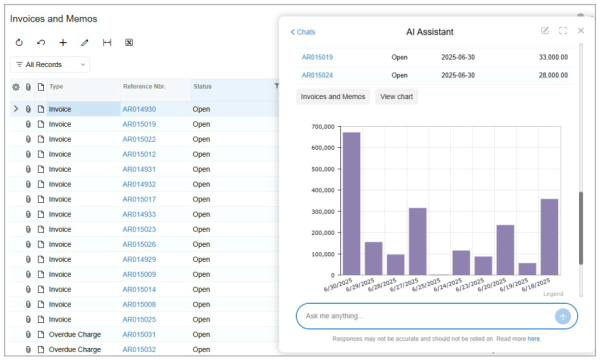
- AI Assistant builds dashboard widgets: users describe what they need and AI creates the matching dashboard component.
- Agentic workflows with tool calling: AI updates data line by line, for example changing prices in bulk on request.
- Data protection when calling LLMs: sensitive fields are replaced with placeholders before being sent to the language model.
- Native data warehouse: a built-in data warehouse for analytical reporting.
- Modern UI by default: the new interface becomes the default experience.
The important point is that AI is only useful when data is complete and correct. A single platform, where every transaction from the job site to accounting is recorded at the source, is the precondition for trustworthy AI answers.
How does S4 localization help when running the entire operation on Acumatica?
Localization means companies do not have to maintain side systems for Vietnam-specific processes, so data truly lives on one platform. S4 localizes Acumatica in depth through these solution packages:
- Accounting under Circular 99/2025/TT-BTC: the VN Financial Localization package, with e-invoice integration.
- Vietnamese payroll: the VN Payroll package with social, health and unemployment insurance, personal income tax, shifts and overtime under Labor Code 45/2019/QH14.
- Fixed assets: fixed asset management under Circular 45/2013/TT-BTC.
- Site safety: the VN Site Safety package under QCVN 18:2021/BXD for construction companies.
There is also a Vietnamese interface and Zalo notifications. When payroll, assets, safety and accounting all sit on Acumatica, questions sent to AI via MCP can cover the entire operation. An overview of the packages is available at the Acumatica localization hub.
Is the cost of a true cloud ERP platform right for Vietnamese companies?
Yes, when placed within the right budget framework. Based on S4’s quotation surveys for companies with VND 500-2,000 billion revenue, Acumatica typically costs about USD 20,000-50,000 per year, or about VND 0.52-1.3 billion at a reference rate of about VND 26,000/USD, and the cost does not rise with the number of users. Compared with the S4 recommended reference framework of 1-2% of revenue for ERP, or VND 5-40 billion per year, the subscription is only a small part.
The rest of the budget should go to the internal ERP team, reporting improvement, integration and AI. This is also why MCP matters: companies can use the AI assistants they already have instead of investing in a separate AI system. If you are weighing platforms, see our NetSuite vs Acumatica vs Business Central comparison.
How should companies prepare to get value from true cloud ERP and AI?
Prepare three things. First, standardize master data (customers, suppliers, items, projects, stores) before connecting AI, because AI cannot fix bad data. Second, design clear role-based permissions, because MCP inherits ERP permissions. Third, pick a few high-value management questions to pilot, such as budget overrun alerts or cash flow, then expand gradually.
S4 Consulting - Acumatica Gold Partner in Vietnam and Oracle NetSuite consultant - can help companies assess data readiness, plan the roadmap for running the entire operation on one platform and pilot AI via MCP safely.
Frequently asked questions
What is true cloud ERP?
It is ERP built for the cloud from the ground up, with the vendor running infrastructure and delivering regular updates, accessible anywhere with one real-time source of data.
What is MCP?
MCP (Model Context Protocol) is an open protocol that lets AI assistants such as Claude and ChatGPT connect securely to ERP data and functions while keeping role-based permissions.
Does Acumatica support MCP?
Yes. Acumatica 2026 R2, released on 1 October 2026, lets companies configure an MCP server in their tenant and turn generic inquiries into tools AI can call.
Does connecting AI via MCP expose sensitive data?
Acumatica 2026 R2 keeps role-based permissions, masks sensitive fields and replaces them with placeholders before sending data to the language model.
How much does Acumatica cost for a VND 500-2,000 billion company?
Based on S4 quotation surveys, about USD 20,000-50,000 per year, or about VND 0.52-1.3 billion, regardless of the number of users.
References
- Accounting Today - Acumatica 2026 R2: native data warehouse, MCP support (01/10/2026)
- IT Brief - Acumatica embeds AI across cloud ERP in 2026 R2 update
- Acumatica - Inter-company accounting
- Acumatica - Leader in the 2026 SMB ERP Technology Value Matrix (Nucleus Research)
- ITPro - NetSuite announces MCP Apps for AI Connector Service (31/03/2026)
- LuatVietnam - Circular 99/2025/TT-BTC replaces Circular 200/2014/TT-BTC