




90-Day Construction ERP Implementation Roadmap
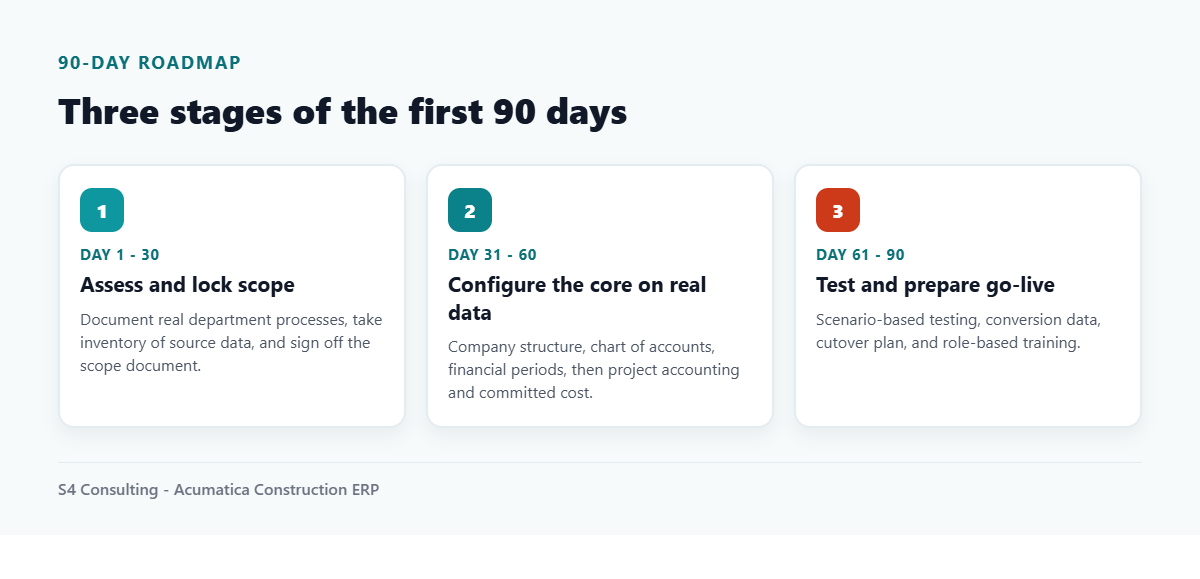
The first 90 days of a construction ERP project are not about going live. The real goal is to lock the scope, clean the source data, and run one complete business cycle from the job site through to the financial statements. Companies that understand this avoid the most common mistake in construction ERP: configuring software before they understand their own processes. Here is how to split 90 days into three 30-day stages, with the deliverable each stage must produce.
Download the Buy Guide: choosing the right construction ERP
A practical guide for CEOs, CFOs and CIOs: warning signs, selection criteria, and benchmark data for construction businesses.
What should happen in the first 30 days of a construction ERP project?
The first thirty days are for understanding the current state and locking scope. The project team walks through the real processes in each department and documents how the company currently handles contracts, progress billing, purchasing, and job cost posting. In parallel, the team takes inventory of source data: the project list, chart of accounts, vendor list, and open contracts.
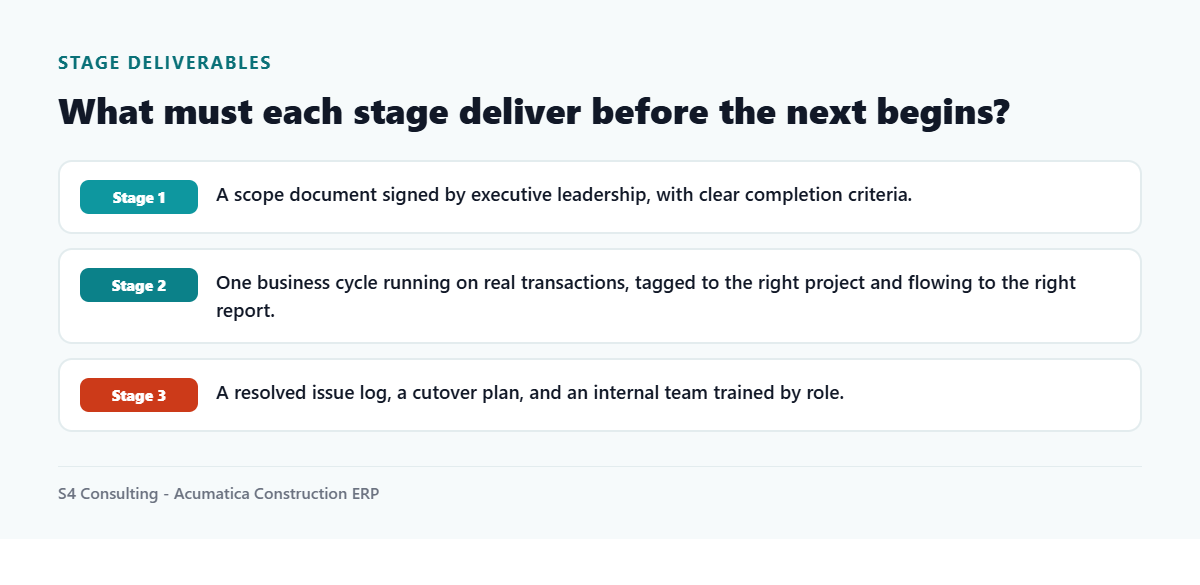
The most important deliverable of this stage is a scope document signed by executive leadership. It states what is in phase one, what is deferred, and what counts as done. In real implementation projects, most disputes about timeline and cost trace back to scope that was never clearly agreed at the start.
What does the middle 30 days focus on?
The second stage is core configuration and internal testing on real data. The team sets up the company structure, chart of accounts, financial periods, and foundational financial modules. Only then does it move to project operations: how a project code attaches to every transaction, how committed cost is recorded, and how progress billing is calculated.
The control point in this stage is that everything must run on real data, not a sample dataset. Only when an accountant posts a real transaction, tags the correct project, and sees the numbers flow into the right report does the company know the configuration is correct.
What does the last 30 days of the 90-day roadmap include?
The final stage covers user testing and go-live preparation. The team runs scenario-based testing so end users operate the system themselves and log issues. In parallel, the company prepares conversion data, builds the cutover plan, and delivers role-based training.
By the end of 90 days the company should have three things: one business cycle that runs end to end, a list of issues either resolved or scheduled, and an internal team confident enough to enter the parallel-run phase.
Why do the first 90 days decide the outcome of a construction ERP project?
The first three months shape everything that follows. If scope is wrong, every later stage has to be redone. If source data is dirty, even correct configuration produces wrong reports. If users are not involved early, the system is abandoned after go-live. This is why the period deserves the strongest staffing, and why the participation of the chief accountant and executive leadership is not optional.
How does Acumatica Construction ERP support this roadmap?
Acumatica Construction ERP is built around the project, so it fits the roadmap above. Three points give mid-size and large construction firms an advantage: user-based licensing is not charged per user, so every site engineer and site management team can be brought onto the system from day one without inflating licence cost; project financials are deep enough to track committed cost and forecast cost at completion inside the first 90 days; and the platform follows advanced governance practice with AI capability for repetitive data entry and reconciliation steps.
In Vietnam, S4 Consulting is a Gold Partner of Acumatica holding more than 31 global certifications. S4 localises Acumatica Construction for Vietnamese businesses through its Financial Localization suite, Vietnamese language packs, e-invoice integration, bank integration, and Excel integration with Velizo, so the accounting team keeps its spreadsheet habits while working from a single source of data.
Frequently asked questions about the first 90 days
Can the 90-day roadmap be shortened to 60 days?
It can, but only when processes are already standardised and data is clean. For companies running many parallel projects or multiple legal entities, compressing the assessment stage usually means redoing configuration later, so total time does not fall while risk rises.
How much should executive leadership be involved in the first 90 days?
At minimum, leadership signs off the scope and approves the process design. Leaders do not need to attend every workshop, but they must decide when departments disagree on how a process should work, which is the most common cause of delay.
Which module should be implemented first?
Start with company structure, chart of accounts, and financial periods, then move to project accounting and purchasing. This order ensures every later transaction attaches to the right financial structure from the start and avoids re-running data.
Which ERP solution fits your construction business?
See how S4 Consulting implements Acumatica Construction ERP for construction businesses in Vietnam, from project financials to e-invoice and bank integration.