




Upgrading FastCons: 3 Options for Construction Companies
What does upgrading FastCons mean for a construction company?
For many construction companies in Vietnam, FastCons has digitized the job site: plans, quantities, materials, site diaries and attendance now live on web and mobile. As the company grows, the next need is usually no longer on site but in project finance, accounting and multi-company management. Upgrading FastCons is therefore not just moving to a newer version – it is deciding where the company’s financial core will sit for the next 3-5 years.
Three options are usually considered: upgrade to FastCons Next, keep FastCons on site and use a cloud ERP as the financial core, or move entirely to a construction ERP such as Acumatica. Each option fits a different stage of growth, and no single option is right for every company.
Mid-Size & Large Construction Companies:
03 Top Global Construction ERPs to Consider
For CEOs, CFOs and CIOs of construction companies planning the next step for their management system.
Download the free ebookOption 1: When does upgrading to FastCons Next make sense?
According to FastWork, FastCons Next adds accounting, inventory with costing, purchasing, sales and manufacturing modules alongside construction project management, built on the open-source ERPNext platform. The accounting module follows the Vietnamese chart of accounts under Circulars 200 and 133. Existing FastCons customers can activate the additional modules without moving to a new environment.
The biggest advantage is minimal disruption: the site team keeps familiar tools, project data is already in place, and implementation cost and time are low. Before deciding, companies should clarify a few points with the vendor:
- Maturity of the accounting module. FastCons Next has been in development since 2024, so ask for references from customers already running accounting on it.
- Multi-company and consolidation. If the company has subsidiaries or joint ventures, request a demo of consolidated reporting and intercompany transactions.
- Customization. Clarify whether specific processes are handled by configuration or can be extended with code.
- Product roadmap. Ask about plans for project finance, estimated cost at completion and AI.
This option suits single-entity, mid-sized companies with relatively simple accounting that want to keep costs low.
Option 2: Does it make sense to keep FastCons on site and add a cloud ERP as the financial core?
Many construction companies choose this path when their field tool runs well but finance is becoming complex. FastCons continues to handle plans, site diaries and site materials, while a cloud ERP such as Acumatica or Oracle NetSuite handles the general ledger, payables and receivables, contracts, project finance, multi-company and consolidation.
The job site is not disrupted, while finance moves up to an international standard. The challenge is integration: the two systems must share project, work item, material and supplier master data and agreed sync rules. FastCons publishes Open APIs, but the scope, cost and sync frequency need to be assessed for each company.
This option suits companies expanding into several entities, with investors or demanding audit requirements, that want to keep the job site stable.
Option 3: What does moving entirely to Acumatica Construction deliver?
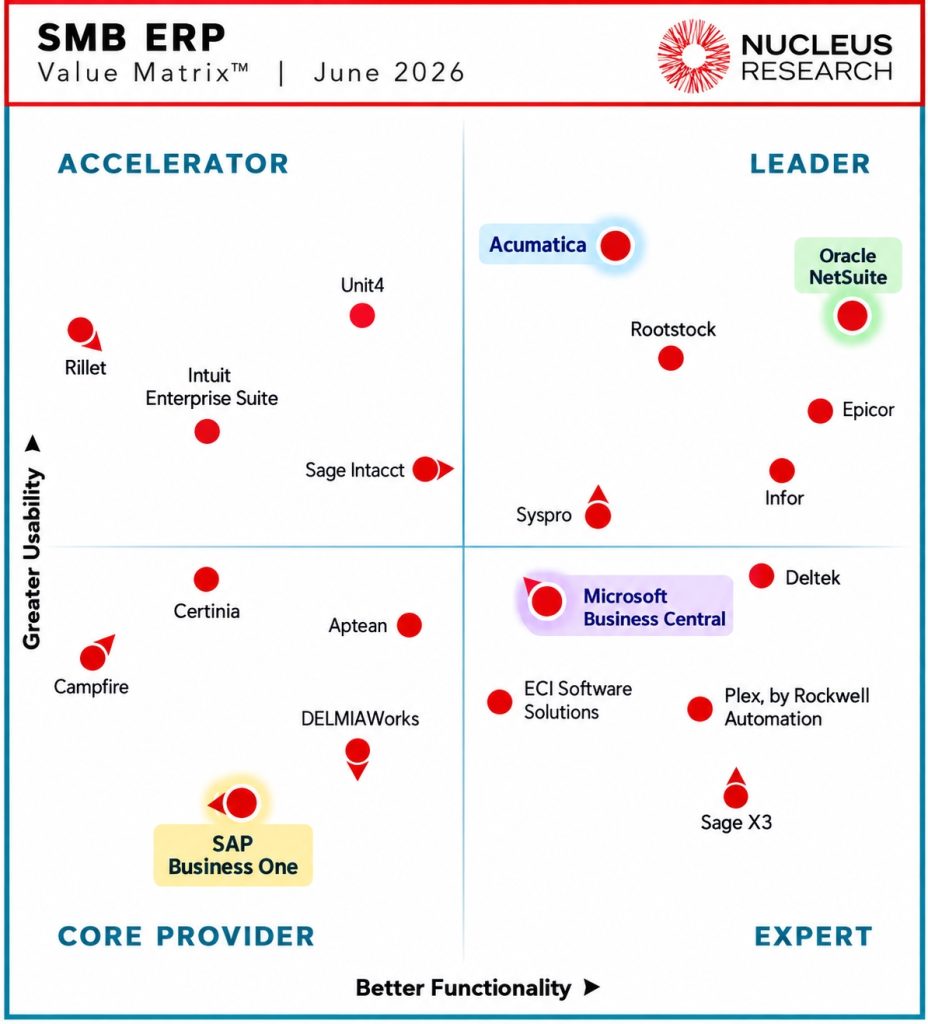
Acumatica Construction Edition puts construction processes in the ERP core: contracts, estimates, subcontracts, change orders, progress billing, retainage, daily field reports, RFIs and site photos on mobile run on the same database as finance, purchasing and inventory. The company has one system and one source of truth. In the SMB ERP Technology Value Matrix 2026, Nucleus Research places Acumatica in the Leaders quadrant.
The Unlimited Users model lets the entire site team use the system without per-user fees. Specific requirements are built with Customization Projects, kept separate from the core so upgrades do not break them. The main challenges are migrating while many projects are still in progress and adapting forms to Ministry of Construction templates and Vietnamese Accounting Standards – usually handled with a localization package and a project-by-project migration plan.
This option suits companies with VND 500-2,000 billion in revenue, many projects running in parallel, many site users and a need for an international platform for the next stage of growth. Learn more about Acumatica ERP for construction.
How do the 3 FastCons upgrade options compare?
Side by side, CEOs and CFOs should look at the following criteria:
| Criteria | FastCons Next | FastCons + cloud ERP | Acumatica Construction |
|---|---|---|---|
| Disruption on site | Low | Low | Medium to high |
| Upfront cost | Low | Medium | Higher |
| Project financial data | Within the FastCons ecosystem | Depends on sync frequency | Real-time on one database |
| Multi-company, consolidation | Confirm with the vendor | Handled by the cloud ERP | Built in |
| Customization | To be clarified | Depends on each system | Configuration and coding, separate from the core |
| Systems to manage | One | Two | One |
| Best fit | Single entity, mid-sized | Expanding into several entities | Mid-size and large, many users |
Compare all three options on the same 5-year TCO, including licenses, implementation, integration, operating staff and the cost of adding companies or projects, rather than first-year cost alone.
Acumatica Construction & Oracle NetSuite:
Which platform fits your construction business?
See how S4 implements construction ERP with accounting, projects and consolidation on one system.
Which option should a company choose?
Start with 3 questions:
- How many legal entities will the company have in 3 years? One entity may be served by option 1. Subsidiaries or joint ventures point to option 2 or 3.
- How many people on site need the system? A large user base makes the licensing model a deciding factor in TCO.
- What do auditors, banks and investors expect? If consolidated reporting and a widely recognized platform are needed, favor an option with a cloud ERP at the core.
Then ask for a demo on the data of projects currently running, not on sample data.
Should you upgrade in the middle of the financial year?
There is no need to rush. Construction companies always have projects in progress, so the sensible timing is to assess and run Fit-Gap in Q4, confirm the option, and go live with the financial core at the start of the next financial year. New projects start on the new system, ongoing projects carry over cumulative figures, and projects close to final settlement can stay on the old system until closed.
Conclusion
Upgrading FastCons is about choosing the financial core for the next stage. FastCons Next suits companies that want to stay in a familiar ecosystem at low cost. Combining FastCons with a cloud ERP suits companies whose finance and consolidation have become complex. Moving entirely to Acumatica Construction suits companies that need one unified system at scale.
As construction companies in Vietnam plan their technology for 2027, it is worth placing all three options on the same evaluation framework. What matters most is not the option with the least change, but the one that fits the company’s operating model, finances and pace of growth.
FAQ
Does upgrading FastCons to FastCons Next require data migration?
According to FastWork, companies activate additional modules and initialize data without moving to a new environment. Confirm the exact scope with the vendor.
Can FastCons integrate with a cloud ERP?
FastCons publishes Open APIs. The scope, cost and sync frequency should be assessed against each company’s processes.
When should a company move entirely to a construction ERP?
When it has several legal entities, many site users, needs real-time project financial data and an international platform for its next stage of growth.
Can Acumatica replace FastCons?
Acumatica Construction Edition can be evaluated as a full replacement, since construction processes, finance and mobile run on one platform.
What should be prepared before upgrading?
Standardize master data, BOQs and norms, decide how to handle projects in progress, count site users and calculate a 5-year TCO for each option.
Sources on FastCons: FastCons product page, FastCons pricing page and the FastCons Next introduction webinar by FastWork, accessed October 2026. Product information may change; companies should confirm details with the vendor.
Mid-Size & Large Construction Companies:
03 Top Global Construction ERPs to Consider
For CEOs, CFOs and CIOs of construction companies planning the next step for their management system.
Download the free ebook