




Construction ERP: 3 Limits as Your Company Grows
Why do construction companies with project software still lack management data?
Many construction companies in Vietnam have already brought project management software to their job sites: schedules, quantities, materials and site diaries are all digitized. Yet when the CEO asks whether a project is making or losing money, the CFO still has to wait for accounting to consolidate and reconcile the numbers. The cause is rarely the job site. It is usually three strategic limits: project data and accounting remain separate, the platform cannot be extended for specific needs, and the system is not ready for a multi-company structure.
These limits tend to surface as the company grows – revenue passes a few hundred billion VND, more projects run in parallel, and subsidiaries, joint ventures or investors appear. Recognizing them early lets leadership plan ahead instead of reacting once the system has become a bottleneck.
Mid-Size & Large Construction Companies:
03 Top Global Construction ERPs to Consider
For CEOs, CFOs and CIOs of construction companies planning the next step for their management system.
Download the free ebookWhy do companies still keep separate accounting software after implementing construction software?
Most construction management solutions are designed from the job site up. They are strong at planning, quantities, materials and site diaries, while the general ledger, payables and receivables, tax and statutory financial statements under Vietnamese Accounting Standards (VAS) often stay in a separate accounting system. Even when a solution adds an accounting module, many companies keep their existing accounting software because it is where the chief accountant, auditors and tax authorities are used to working.
As a result, the same transaction – a material receipt, a subcontractor certification, a supplier payment – is recorded in two places, in two different ways. This is the information gap that project finance teams feel most. It typically leads to:
- Late project financial reports. Costs are only complete once accounting has posted them and reconciled them with site data, usually after the monthly close.
- No real-time view. Leadership sees what happened weeks ago, not what is happening today.
- Inaccurate numbers. Project codes, work items and cost objects do not match across the two systems and have to be adjusted in Excel.
- True project profit is only known at final settlement. By then, the chance to correct costs has passed.
When project and financial data share one database, every transaction on site is also an accounting entry. That is the prerequisite for real-time project profit and loss, estimated cost at completion and project cash flow.
What is the impact of a platform that allows configuration but not coding?
Many construction management solutions are delivered as shared SaaS: the company subscribes and configures predefined parameters, while the source code and product roadmap are controlled by the vendor. This model has clear advantages – fast deployment, low upfront cost and continuous updates.
The limit appears when a company has specific processes that configuration cannot cover: payment application formats for each project owner, allocation of overhead to projects, multi-level change approval, or integration with estimating software, banks or a parent company’s system. The company is then left with two options: wait for the vendor to add it to the roadmap, or handle it outside the system in Excel.
Global cloud ERP platforms such as Acumatica and Oracle NetSuite also run in the cloud, but they let companies and implementation partners build coded extensions with dedicated toolkits (Acumatica Customization Projects, NetSuite SuiteScript), kept separate from the core. Specific requirements are met while the system still follows the vendor’s upgrade roadmap.
What does the system need when a construction company becomes a group?
A construction company with VND 500-2,000 billion in revenue rarely does construction only. It often has subsidiaries, joint ventures, factories for steel structures, concrete or interior fit-out, and a trading arm for materials and equipment. Each unit runs a different business model, but leadership needs one consolidated financial picture. At this stage the management system needs:
- Multi-company and intercompany transactions. Sales, loans and material transfers between units are recorded and eliminated on consolidation.
- Fast consolidated reporting. No more exporting each company’s data to Excel and stitching it together every period.
- Multi-currency. To support foreign-invested projects, investors or an overseas parent company.
- Several business models on one platform. Construction, manufacturing and trading run on a single system.
At this stage, the reputation of the platform also matters. Auditors, banks, investment funds and foreign partners often expect the company to run on a widely recognized management system with a long-term product roadmap and a professional network of implementation partners.
How does construction project management software differ from a global construction ERP?
The two types of solution serve different stages of growth. When comparing them, CEOs and CFOs should look at the following criteria:
| Criteria | Construction project management software | Global construction ERP |
|---|---|---|
| Scope | Sites, projects, part of the back office | Whole company: finance, purchasing, inventory, projects, subcontractors, HR |
| Financial data | Often separate from accounting | One database for every process |
| Reporting | Per project, compiled per period | Real-time, consolidated, with forecasts |
| Extending for specific needs | Mostly configuration | Configuration and coding, separate from the core |
| Multi-company | Limited, consolidated in Excel | Multi-entity, intercompany, multi-currency |
| Product roadmap | Depends on vendor capacity | 2 major releases a year, public roadmap |
| Cost | Low to start | Higher, offset by scalability |
No option is right for every company. What matters is knowing which stage the company is in and what it will need over the next 3-5 years.
How does Acumatica Construction Edition address these limits?
Acumatica Construction Edition puts construction processes in the ERP core: contracts, estimates, subcontracts, change orders, progress billing, retainage and work in progress run on the same database as finance, purchasing and inventory. Every transaction on site updates project financials at the same time. In the SMB ERP Technology Value Matrix 2026, Nucleus Research places Acumatica in the Leaders quadrant.
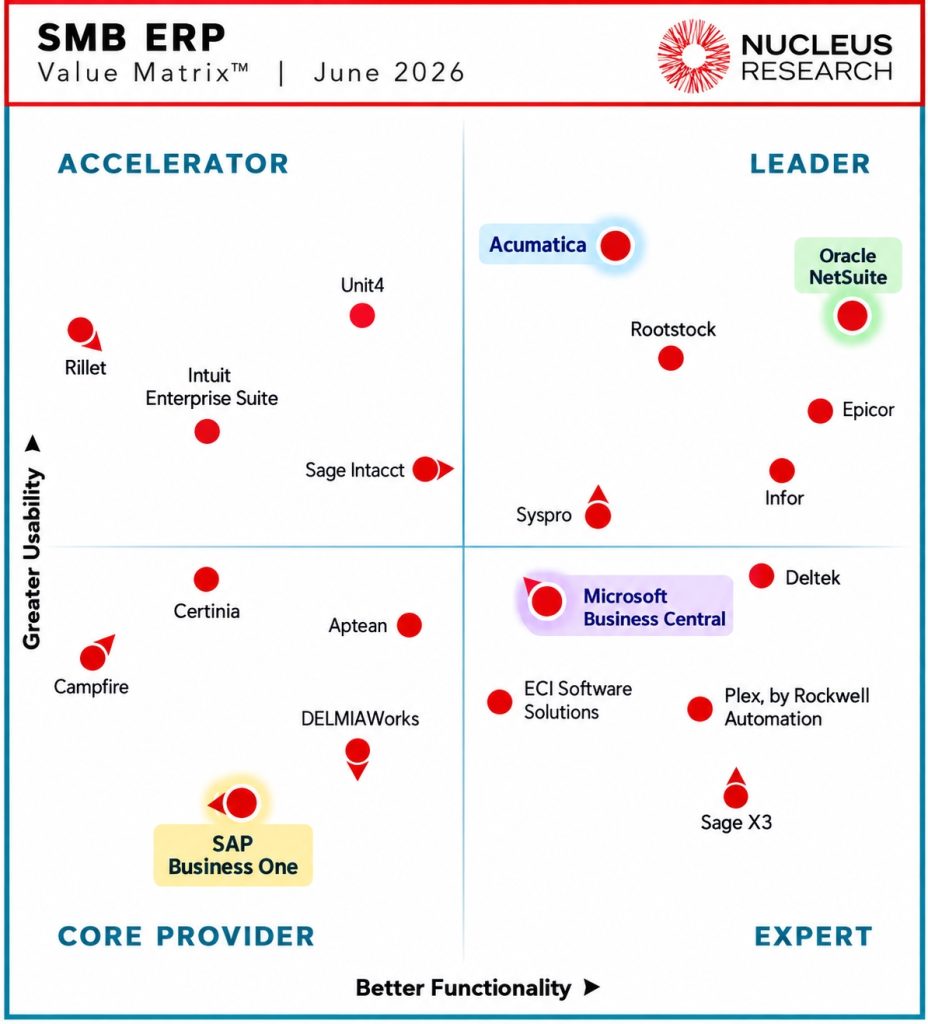
Acumatica uses an Unlimited Users model, so site managers, engineers, QS, storekeepers and site accountants can all use the system without per-user fees. Specific requirements are built with Customization Projects, kept separate from the core so upgrades do not break them. Acumatica also supports multi-company, intercompany transactions and consolidated reporting, along with manufacturing and distribution modules for group structures. Learn more about Acumatica ERP for construction and rolling out a multi-company construction ERP.
Which construction companies is Oracle NetSuite a good fit for?
Oracle NetSuite is also in the Leaders quadrant of Nucleus Research 2026, with strengths in group finance: multi-entity, multi-currency, intercompany accounting, fast consolidation and a fast close. NetSuite is especially worth considering for construction holding companies with many subsidiaries, joint ventures or foreign investors.
For deep construction processes such as progress billing, retainage, change orders and subcontracts, NetSuite needs a construction SuiteApp from a partner. Specific requirements are extended with SuiteScript, also kept separate from the core. The practical question is therefore not “which platform is better”, but whether the company needs an ERP that is strongest in site operations or in group finance.
Acumatica Construction & Oracle NetSuite:
Which platform fits your construction business?
See how S4 implements construction ERP with accounting, projects and consolidation on one system.
Do we need to replace the construction management software we use today?
Not necessarily. If the company still operates mainly as one legal entity, accounting runs smoothly and the current software serves the job sites well, continuing to use and standardize processes on the existing system can be a sensible choice.
When the three limits above start to affect leadership decisions, companies can consider two paths: keep their familiar field tools and move the financial management core to a cloud ERP, or switch entirely when the ERP offers deep enough construction functionality. Either way, the decision should be based on the company’s real data, not a sample demo.
Where should a construction company start assessing its current system?
Start with 5 questions that leadership should be able to answer directly in the system:
- Is the project making or losing money? Can I see the actual profit and margin of each project today?
- How will the project end? Can I see the estimated cost at completion and expected final profit?
- Is the budget being exceeded? Can I see budget, committed and actual cost for each project and know which items are at risk of overrunning?
- Where is the cash, and where will it run short? Can I see what has been invoiced, collected and still receivable, and the project’s projected cash flow?
- Is there anything I need to step in on right now? Does the system proactively alert me when cost, schedule, receivables or margin look unusual?
If most answers depend on Excel or on waiting for the accounting close, it is a signal to reassess the architecture of the management system.
Conclusion
Digitizing the job site is an important first step, but not the destination. As a construction company grows, three limits – separate project and accounting data, a configuration-only platform, and a system not ready for multiple companies – gradually become barriers to leadership decisions.
As construction companies in Vietnam plan their technology for 2027, global construction ERPs such as Acumatica and Oracle NetSuite can be shortlisted for comparison with the current system. What matters most is not the platform with the most features, but the one that fits the company’s operating model, finances and pace of growth.
FAQ
Can construction project management software replace accounting software?
It depends on the solution. Many construction management tools focus on the job site, so companies keep a separate accounting system. In that case, factor in the cost of reconciling data and the delay in project financial reporting.
Why are construction project financial reports often late?
Because site data and accounting data live in two systems. Figures are only complete after accounting has posted and reconciled them, usually after the monthly close.
Does a cloud ERP mean you cannot code for your specific needs?
No. Many global cloud ERPs such as Acumatica and Oracle NetSuite allow coded extensions with their own toolkits, kept separate from the core. The difference is whether a platform allows configuration only, or configuration and coding.
When does a construction company need a global ERP?
When it has several legal entities, needs fast consolidated reporting, works with foreign investors or partners, or expands into manufacturing and materials trading.
Do we need to replace the construction management software we use today?
Not necessarily. Many companies keep their familiar field tools and move only the financial management core to a cloud ERP. The decision should be based on the company’s own data and processes.
Mid-Size & Large Construction Companies:
03 Top Global Construction ERPs to Consider
For CEOs, CFOs and CIOs of construction companies planning the next step for their management system.
Download the free ebook