




Replacing FastCons: 3 Cloud ERP Options for Construction
When should a company using FastCons consider replacing it?
Many construction companies in Vietnam use FastCons to digitize the job site: plans, quantities, materials, site diaries and attendance. Replacement only makes sense once the company has outgrown what construction project management software is designed for – project financial data is still separate from accounting, specific processes cannot be met through configuration, and the company has grown into several entities that need consolidation.
If FastCons still serves the business well and the company operates mainly as one legal entity, continuing with the current system is a sensible choice. This article is for companies that already see these limits clearly and want to know which cloud ERP options are worth shortlisting.
Mid-Size & Large Construction Companies:
03 Top Global Construction ERPs to Consider
For CEOs, CFOs and CIOs of construction companies planning the next step for their management system.
Download the free ebookWhat 4 signs show it is time to reassess the system?
Project management software has helped many construction companies move off Zalo and Excel. Once revenue passes a few hundred billion VND, the challenge shifts from managing sites to managing the whole company. Four signs are common:
- Quantities without values. Estimated cost at completion, remaining cost and committed cost are incomplete, so leadership struggles to spot budget overrun risks early.
- Backward-looking management. Reports describe what has already happened, often days or weeks late, without project-level cash flow and profit forecasts.
- Service not at enterprise level. The management system is mission-critical and needs consultants who understand both finance and construction, clear SLAs and a long-term commitment.
- Growth barriers. Subsidiaries, joint ventures, factories and a materials trading arm make consolidated reporting increasingly complex.
If several signs appear at once, compare the cost of extending the current system with the cost of moving to a cloud ERP on the same 3-5 year TCO.
What cloud ERP options exist for construction in 2026?
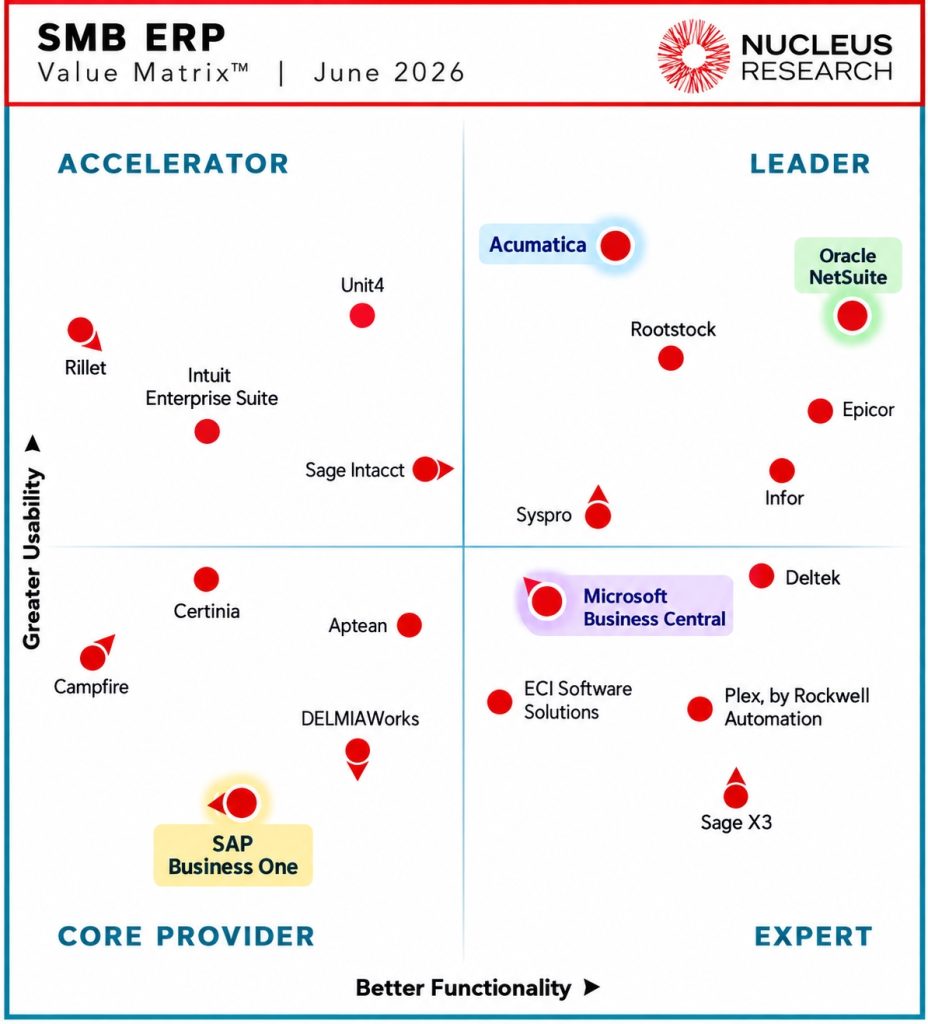
According to Nucleus Research’s SMB ERP Technology Value Matrix (June 2026), the Leaders quadrant includes Acumatica and Oracle NetSuite alongside Epicor, Infor, Rootstock and Syspro, while Microsoft Dynamics 365 Business Central sits in the Expert quadrant. For construction, the biggest difference between platforms is whether construction functionality is built into the core or added through third-party apps.
| Criteria | Acumatica Construction | Oracle NetSuite + SuiteProjects Pro | Microsoft Dynamics 365 Business Central |
|---|---|---|---|
| Value Matrix 2026 position | Leader | Leader | Expert |
| Design philosophy | Operation First | Financial First | Financial First |
| Construction functionality | Built into the Construction Edition | Projects built in, deep construction via SuiteApps | Basic job costing, construction via third-party apps |
| Subcontracts, change orders, retainage | Built in | Requires a construction SuiteApp | Requires a third-party app |
| Daily field reports, RFIs | Built in, on mobile | Requires a SuiteApp or integration | Requires an app or Power Apps |
| Licensing model | Unlimited Users | Per user and service tier | Per user, construction app extra |
| Embedded AI | AI Studio, AI Assistant | NetSuite Next, SuiteAgents | Microsoft Copilot |
| Best fit | General contractors, MEP, fit-out firms with many projects | Multi-entity groups with foreign investment | Companies standardized on Microsoft 365 |
Option 1: What are the strengths and weaknesses of Acumatica Construction Edition?
Its biggest strength is that construction lives in the ERP core. Contracts, estimates, subcontracts, change orders, progress billing, retainage and work in progress run on the same database as finance, purchasing and inventory. Daily field reports, RFIs, drawings and site photos are available on mobile. The Unlimited Users model lets the entire site team use it without per-user fees.
The challenge is that some standard forms are designed for the global market and must be adapted to Ministry of Construction certification and payment templates and to Vietnamese Accounting Standards. The usual remedy is the implementation partner’s VAS, e-invoice and Vietnamese form localization package, mapping BOQs, norms and cost codes during Fit-Gap, and building specific requirements with Customization Projects kept separate from the core. Based on S4’s implementation experience in Vietnam, a reference subscription for a 100-user contractor typically falls between USD 20,000 and 50,000 per year, excluding implementation, and does not change as users are added.
Option 2: Which construction companies is Oracle NetSuite a good fit for?
Oracle NetSuite is a unified cloud ERP platform strong in group finance: multi-entity, multi-currency, intercompany accounting and near-instant consolidated reporting. SuiteProjects Pro adds project, resource and project accounting capabilities. NetSuite suits construction holding companies with many subsidiaries, joint ventures or foreign investors.
The challenge is that deep construction processes such as progress billing, retainage, change orders and subcontracts require a partner’s construction SuiteApp, and per-user licensing makes costs rise quickly when many site staff need access. A 2-Tier model reduces the user count: NetSuite serves as the financial core, while processes involving many people, such as material requests, budgets and advances, run on the S4 eSuite satellite solutions under an Unlimited Users policy. A reference subscription for 100 users typically falls between USD 70,000 and 170,000 per year, excluding implementation.
Acumatica Construction & Oracle NetSuite:
Which platform fits your construction business?
See how S4 implements construction ERP with accounting, projects and consolidation on one system.
Option 3: When does Microsoft Dynamics 365 Business Central fit?
Business Central integrates deeply with Microsoft 365, Teams, Excel, Power BI and Power Apps, includes Copilot in daily work, and supports multi-company, multi-currency and budget versus actual. It is a natural choice for companies already standardized on the Microsoft ecosystem.
The standard product only has basic job costing. Progress billing, retainage, subcontracts, change orders and daily field reports require third-party apps on AppSource, usually priced per user alongside Business Central licenses. Based on list prices at the time of writing, Essentials plus a popular construction app comes to about USD 150 per user per month, or roughly USD 180,000 per year for 100 users, excluding implementation.
What should be prepared before moving from FastCons to a cloud ERP?
Construction companies rarely have a quiet moment to switch systems. These five steps help ensure a safe transition, whichever platform you choose:
- Set the migration strategy by project. New projects start on the new ERP, ongoing projects carry over cumulative figures, and projects close to final settlement can stay on the old system until closed.
- Standardize master data. Material lists, cost codes, BOQ structures, norms, subcontractors and suppliers – usually the most time-consuming part.
- Run Fit-Gap on real data. Progress certification and payment requests using Ministry of Construction templates, retainage, change-order appendices, VAS and e-invoicing. Every gap must be quantified in cost and time.
- Count site users carefully. Per-user versus Unlimited Users licensing determines most of the cost and how widely the system is actually used.
- Calculate a 3-5 year TCO based on the growth plan. Compare it with the real cost of maintaining and extending the current system.
Should you replace FastCons while many projects are still in progress?
Avoid an all-at-once switch. The safer path has three phases: assessment and Fit-Gap to confirm scope and platform; core deployment of finance, contracts, purchasing and project costs with cumulative balances migrated; then expansion to the job site, mobile and AI. During the transition, FastCons can continue to serve older projects.
Conclusion
Replacing FastCons is a long-term investment decision that only makes sense once a company has outgrown construction project management software. Acumatica Construction suits companies that need deep construction functionality and many site users, Oracle NetSuite suits multi-entity groups, and Business Central suits companies already tied to the Microsoft ecosystem.
As construction companies in Vietnam plan their technology for 2027, shortlist the options, ask for demos on real project data and compare them on the same TCO framework rather than on first-year license price alone.
FAQ
What are the options for replacing FastCons?
The three options usually considered are Acumatica Construction Edition, Oracle NetSuite with SuiteProjects Pro and a construction SuiteApp, and Microsoft Dynamics 365 Business Central with a construction app from AppSource.
How is Acumatica Construction different from construction project management software?
Acumatica is a company-wide cloud ERP with construction built into the core alongside finance, purchasing and inventory, so site and financial data share one database.
How much does it cost to replace FastCons with a cloud ERP?
It depends on the platform and number of users. Based on S4’s experience, a 100-user subscription is roughly USD 20,000-50,000 per year for Acumatica and USD 70,000-170,000 per year for NetSuite, excluding implementation.
Will migration disrupt projects under construction?
Disruption can be limited by migrating project by project: new projects use the new system, ongoing projects carry over cumulative figures, and projects near settlement stay on the old system.
Can we keep FastCons and add a cloud ERP?
Yes. Many companies keep their familiar field tool and move only the financial core to a cloud ERP, provided the integration scope is assessed carefully.
Sources on FastCons: FastCons product page, FastCons pricing page and the FastCons Next introduction webinar by FastWork, accessed October 2026. Product information may change; companies should confirm details with the vendor.
Mid-Size & Large Construction Companies:
03 Top Global Construction ERPs to Consider
For CEOs, CFOs and CIOs of construction companies planning the next step for their management system.
Download the free ebook