


Enterprise Architecture in the AI Era: When Integration Barriers Fall
Enterprise architecture in the AI era (Enterprise Architecture - EA) is no longer driven by the question “is integration difficult?”, but by the question “how much value does each system tier create relative to its cost of ownership?”. As AI coding assistants, automation platforms such as n8n and the MCP protocol sharply reduce the cost of integration, companies are no longer forced to choose “all-in-one or nothing”. The direct consequence is that the two-tier ERP model is becoming a global trend for multi-entity groups.
This article by S4 Consulting - Acumatica Gold Partner in Vietnam and Oracle NetSuite consulting firm - summarizes five key arguments about EA in the AI era for CEOs, CFOs and CIOs who are planning the next cycle of investment in ERP and the systems around it.
How is enterprise architecture in the AI era different from before?
The core difference is that the cost and time of integration have fallen sharply, so the architecture can become more flexible without inflating cost. In the past, every connection between ERP, POS, banks or e-invoicing was a separate project lasting several weeks, so many companies chose a single software suite to avoid integration risk. In the AI era, engineers can use AI assistants to read API documentation, generate code and write tests; workflow platforms such as n8n offer hundreds of prebuilt integrations; and MCP (Model Context Protocol), announced by Anthropic on 25 November 2024, has become an open standard for AI assistants to connect securely to data and tools. EA is therefore shifting from “pick one system that does everything” to a flexible, composable architecture: each tier uses the platform that fits it best, connected through APIs and governed by shared data rules.
Why does AI remove integration limits and vendor lock-in?
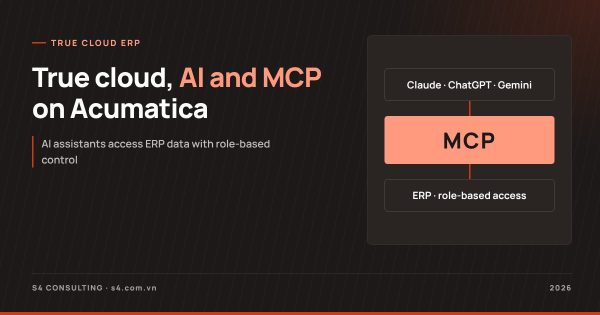
AI reduces switching costs and connection costs, which are the two main sources of vendor lock-in. Companies get “locked in” mainly because every data flow, report and customization is tied to the proprietary technology of one system. When AI assistants help engineers understand legacy code, map data fields and generate new connection layers faster, the price of replacing one component drops significantly. The major ERP vendors are also moving in an open direction: NetSuite announced its AI Connector Service, connecting AI assistants via MCP, in August 2025, and Acumatica 2026 R2 (1 October 2026) allows an MCP server to be configured inside the tenant with role-based permissions. Architecture decisions can now be based on value rather than on fear of integration.
Enterprise Architecture in the AI Era: From Composable to AI-Ready
An executive evening for leaders of multi-entity groups, 18:30 - 21:15, Thursday 19 November 2026, Ho Chi Minh City.
Are programming languages still a barrier for in-house IT teams?
They are no longer the major barrier they used to be. An in-house team that specializes in Python can still work with .NET, Java, JavaScript, Business Central AL or NetSuite SuiteScript when AI coding assistants help with syntax, libraries and code patterns. A common way of working today is to describe the requirement in natural language, let the AI assistant generate the code, and have the engineer review and adjust it. However, the engineer’s role does not disappear; it shifts toward solution design, testing, security, code review and understanding the business process.
Can an integration package really be finished in about one day?
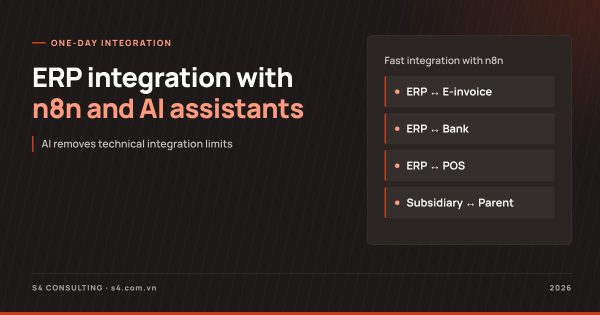
It can, under clear conditions. For common integrations such as pushing invoices to an e-invoice provider, reconciling bank statements, sending approval notifications through Zalo or synchronizing subsidiary balances to the parent company, when the API already exists and is well documented, one engineer using n8n together with an AI coding assistant can build a working version in about one working day. The conditions are: API access already granted, clean master data, test scenarios, logging and error alerts, secret management and version control. Complex integrations such as two-way order synchronization with many statuses, historical data migration or consolidation logic will take longer. The important point is that “one day” changes how cost is calculated in EA; it is not a promise for every case.
Why will IT cost optimization shape EA in the coming period?
Because once integration cost is no longer the barrier, the remaining deciding variable is the cost of ownership and the value of each tier. The argument “integration is hard, so we must buy the whole suite” used to make companies pay group-level ERP licenses even for small units. Now the CFO can ask again: which tier needs the most powerful platform, and which tier only needs something lean, fast to deploy and reasonably priced? The reference framework recommended by S4 is to allocate about 1-2% of revenue each year to the total cost of owning and developing ERP, including subscriptions, the internal team, partners, integration, training and AI. When money is not locked into unused licenses, most of the budget can go to people, process improvement and AI. You can see the detailed calculation in the article on the golden ratio of 1-2% of revenue.
| Criteria | Traditional EA | EA in the AI era |
|---|---|---|
| Integration cost | High, each connection is a project | Sharply lower thanks to AI assistants, n8n, open APIs |
| System selection principle | Buy the full suite to avoid integration | Choose by value and cost of each tier |
| Vendor lock-in | Hard to escape, high switching cost | Reduced thanks to open standards such as MCP, APIs |
| Role of in-house IT | Limited by programming language | Design, testing, security, review |
| Group ERP model | One ERP for every unit | Two-tier ERP: group core and subsidiaries |
Why is two-tier ERP a global trend?
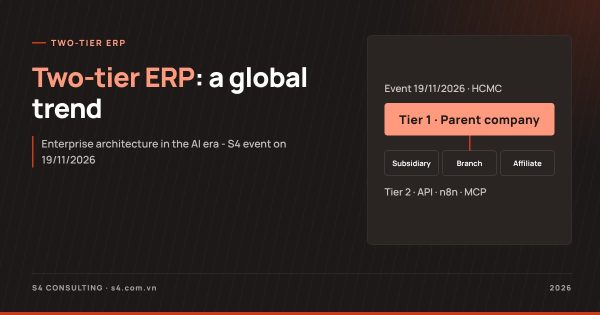
Two-tier ERP is the natural conclusion of the four arguments above. According to TechTarget (January 2024), two-tier ERP is a strategy of large and multinational enterprises: tier 1 handles finance and shared core processes at group level, while tier 2 serves subsidiaries, business units and smaller locations, reducing cost compared with running a tier-1 ERP everywhere. For Vietnamese groups, tier 2 can be a lean, localized cloud ERP that connects back to tier 1 through APIs, n8n or MCP. A detailed analysis of each tier’s role and the criteria for choosing ERP for subsidiaries is available in the pillar article on two-tier ERP (2-tier ERP) and in the 2-Tier ERP & Composable EA white paper.
Where should a company start?
Start with a map of the current applications and data flows, then define the core that must be standardized:
- System inventory: list the ERP, industry software, data flows and the cost of ownership of each component.
- Master data standardization: align the chart of accounts, master lists and intercompany transaction rules.
- Tier 1 and tier 2 definition: decide which consolidation capabilities the parent company needs, and which industry processes and localization each subsidiary needs.
- Small pilot: build one flow, such as synchronizing subsidiary balances with n8n, and measure time and risk.
- Governance rules: set permissions, API key management, review of AI-generated code and error monitoring.
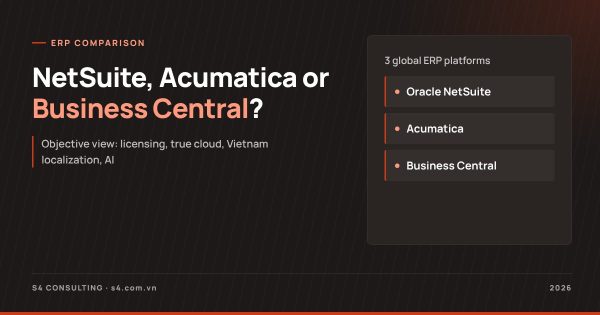
AI makes integration cheaper but does not remove the need for standard data governance and internal control; a solid financial core is still the foundation. For further reading, see the comparison of three ERP platforms and true cloud ERP, AI and MCP.
We invite you to join the executive evening Multi-Entity Groups: Beating in Sync to Accelerate on 19 November 2026 in Ho Chi Minh City to hear first-hand about enterprise architecture in the AI era and two-tier ERP.
Frequently asked questions
What is enterprise architecture (EA)?
EA is the overall blueprint of a company’s processes, data, applications and technology, ensuring that systems serve the business strategy.
How does AI change enterprise architecture?
AI sharply reduces the cost and time of integration, so companies can choose the right platform for each tier instead of being forced to buy a full suite from one vendor.
What is MCP?
MCP (Model Context Protocol) is an open standard announced by Anthropic on 25 November 2024 that lets AI assistants connect securely to data and tools while respecting role-based permissions.
Can every ERP integration be finished in one day?
No. About one day is feasible for common integrations with existing APIs, clear documentation and clean data; complex two-way integrations or large data migrations take longer.
Which companies is two-tier ERP suitable for?
It suits groups with multiple subsidiaries, branches, associates or newly acquired units that need a lean ERP while still connecting data to the parent company.
References
- Anthropic - Introducing the Model Context Protocol (25/11/2024)
- n8n - GitHub repository (fair-code workflow automation, AI agents)
- TechTarget - What is two-tier ERP? (01/2024)
- Insightful Accountant - Oracle NetSuite announces NetSuite AI Connector Service (14/08/2025)
- Accounting Today - Acumatica 2026 R2: native data warehouse, MCP support (01/10/2026)