


Two-Tier ERP: Why Is It a Global Trend as IT Cost Shapes Architecture?
Two-tier ERP (2-tier ERP) is a model in which a group uses a core ERP at the parent company for consolidated finance and common standards, while subsidiaries, branches, associates or newly acquired units run a leaner cloud ERP. The model has become a global trend because integration costs have fallen sharply in the AI era, so architecture decisions are now based on the cost of ownership and the value of each tier rather than on “buying the full suite for every location”.
This article by S4 Consulting - Acumatica Gold Partner in Vietnam and Oracle NetSuite consulting firm - goes deeper into the definition, the criteria for selecting a tier-2 ERP, integration options and group data governance, so that CEOs, CFOs and CIOs can assess whether the model fits their organization.
What is two-tier ERP?
Two-tier ERP is a strategy of tiering the ERP landscape according to the role of each unit in the group. According to TechTarget (January 2024), tier 1 handles finance and shared core processes at group level, while tier 2 serves business units, subsidiaries and smaller locations. The stated benefits include lower cost compared with using a tier-1 ERP everywhere, industry-specific functionality, the ability to meet local requirements for language and currency, ease of use and flexibility. The key point is that the two tiers do not operate independently: financial data, master data and intercompany transactions must flow to tier 1 under consistent rules so that the parent company has timely consolidated figures.
Why is two-tier ERP becoming a trend now?
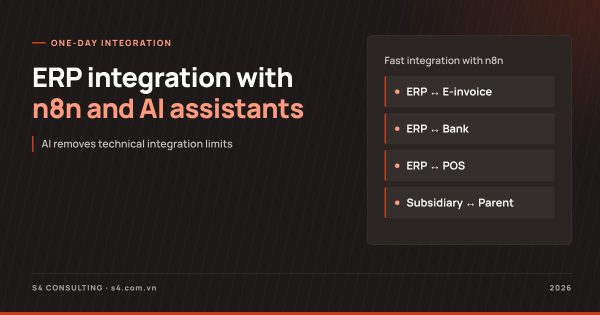
Because the biggest barrier to the model, integration, has dropped sharply. In the past, connecting two ERPs from different vendors required a long programming project and high maintenance costs, so many groups chose a single ERP for all units even though small subsidiaries needed only part of its functionality. Today AI coding assistants, workflow platforms such as n8n and the MCP protocol make it faster to build and maintain connections, and many ERP platforms now offer open APIs and MCP support. IT cost therefore becomes the factor that shapes the architecture: tier 1 receives investment in consolidation and control capabilities, while tier 2 optimizes cost, deployment speed and industry processes. The underlying arguments are presented in the pillar article on enterprise architecture in the AI era.
What roles do tier 1 and tier 2 play?
Tier 1 holds the standards and the consolidated figures, while tier 2 serves the day-to-day operations of each unit. The table below summarizes a typical division of roles:
| Area | Tier-1 ERP (parent company) | Tier-2 ERP (subsidiaries, associates) |
|---|---|---|
| Main objective | Consolidated finance, common standards, control | Industry operations, speed, reasonable cost |
| Scope | Group chart of accounts, consolidation, treasury, management reporting | Sales, purchasing, inventory, production or projects, local accounting |
| Localization needs | Group standards, possibly IFRS in parallel with VAS | Accounting under Circular 99/2025/TT-BTC, e-invoicing, Vietnamese payroll |
| Deployment time | Longer, larger scale | Short, can be replicated for new units |
| Integration | Receives summarized data, intercompany transactions | Pushes balances, transactions, master data via API, n8n, MCP |
Two-Tier ERP: Best Practice for Choosing ERP for Subsidiaries and Associates
Lac Pham, CEO of S4 Consulting, speaks at an executive evening, 18:30 - 21:15, Thursday 19 November 2026, Ho Chi Minh City.
What are the criteria for choosing a tier-2 ERP for subsidiaries and associates?
A tier-2 ERP should be selected against five groups of criteria, not on license price alone. Specifically:
- True cloud and open APIs: a genuine cloud system with regular updates and complete APIs to connect back to tier 1 without a complex middleware layer.
- A suitable pricing model: labor-intensive units such as factories, construction sites and store chains should consider a model that does not charge per user; units with few users may suit a per-user model.
- Industry processes: industry editions for construction, manufacturing, distribution and retail reduce customization.
- Vietnamese localization: accounting under Circular 99, e-invoicing, payroll and a Vietnamese user interface.
- Replicability: fast deployment for newly established or newly acquired companies from a standard template.
On budget, the reference framework recommended by S4 is to allocate 1-2% of revenue each year to the total cost of owning and developing ERP; in a two-tier model, the CFO should calculate it separately for each tier to see where the group is overpaying.
Should the two tiers be integrated via API, n8n or MCP?
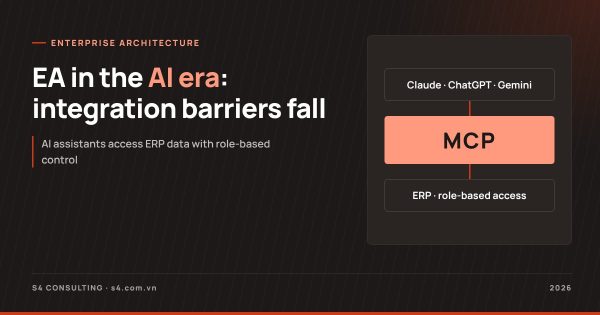
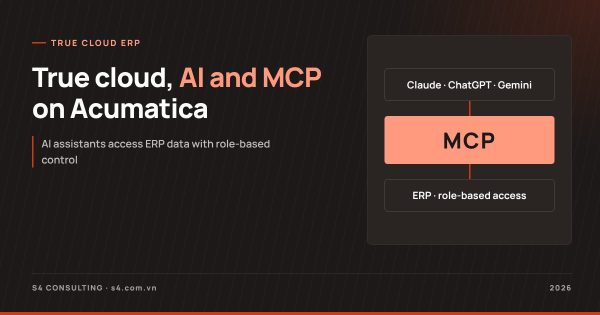
Each option serves a different purpose, and many groups combine them. Direct API integration suits stable, high-volume transaction flows that require tight control, such as synchronizing journal entries, balances and intercompany invoices. n8n is a fair-code platform that can be self-hosted or used in the cloud, combining drag-and-drop with JavaScript and Python; it is well suited to orchestrating many small flows with schedules, error alerts and easy changes when processes evolve. MCP serves the query and action layer of AI assistants: executives can ask about the figures of multiple companies through Claude or ChatGPT while role-based permissions remain in place. NetSuite has offered its AI Connector Service via MCP since August 2025, Business Central is opening the way to an MCP server from 2025 release wave 2, and Acumatica 2026 R2 allows an MCP server to be configured inside the tenant. MCP complements, rather than replaces, the transaction integration layer.
What does data governance require in a two-tier ERP model?
It requires four governance pillars before any discussion of tools. First, chart of accounts mapping: a subsidiary’s local accounts under Circular 99 must be clearly mapped to the group chart of accounts, with rules for when new accounts are created. Second, master data: customer, supplier, item and cost center codes need a single place of management and an approval process. Third, intercompany transactions: sales, loans and cost allocations between companies must be recorded on both sides and reconciled periodically. Fourth, consolidation: a common closing calendar, currency translation rules and elimination of intercompany transactions. In Acumatica, intercompany accounting supports an unlimited number of companies, automatic intercompany entries and consolidated reports that eliminate intercompany transactions; NetSuite OneWorld is also strong in multi-company and multi-currency operations.
Which candidates fit tier 1 and tier 2 in Vietnam?
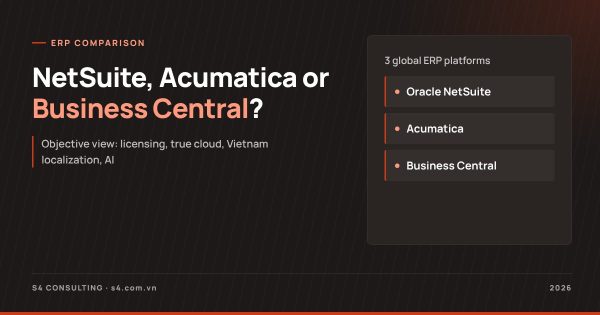
Oracle NetSuite, Acumatica and Microsoft Dynamics 365 Business Central are all candidates worth shortlisting, depending on the role. NetSuite fits tier 1 when the group is multinational, has a parent company abroad, and needs OneWorld and strong consolidation; it can also serve as tier 2 for subsidiaries of groups already on NetSuite, with the NetSuite V2.0 accounting localization package for Circular 99 developed by S4. Acumatica fits tier 2 for labor-intensive subsidiaries because it does not charge per user, offers industry editions and is deeply localized by S4; for mid-sized groups, Acumatica can also be tier 1 thanks to intercompany accounting with unlimited companies. Business Central is strong when the group has standardized on Microsoft 365 and Power BI; points to consider are per-user pricing of USD 80 or 110 per month and Vietnamese localization that depends on partner apps. Implementation details are covered in 2-tier ERP in Vietnam and the 2-Tier ERP & Composable EA white paper.
We invite you to join Multi-Entity Groups: Beating in Sync to Accelerate on the evening of 19 November 2026 to hear the session “Two-tier ERP: best practice for choosing ERP for subsidiaries and associates”.
Frequently asked questions
What is two-tier ERP?
It is a model that uses a core ERP at the parent company for consolidated finance and a leaner ERP at subsidiaries, branches and associates, with data connected between them.
Why does two-tier ERP save cost?
Subsidiaries do not pay group-level ERP costs for functions they do not use, while integration with tier 1 is becoming cheaper thanks to APIs, n8n and AI.
Does tier 2 need Vietnamese localization?
Yes. Subsidiaries in Vietnam need accounting under Circular 99/2025/TT-BTC, e-invoicing and payroll that follows Vietnamese regulations.
Does MCP replace API integration between the two tiers?
No. MCP serves AI assistants for permission-controlled queries and actions; transaction flows such as journal entries and balances should still go through APIs or controlled workflows.
Can the same ERP be used for both tiers?
Yes. Many groups use the same platform with different configurations; the decision should be based on cost of ownership, industry processes and consolidation capability.
References
- TechTarget - What is two-tier ERP? (01/2024)
- Acumatica - Inter-company accounting
- Insightful Accountant - Oracle NetSuite announces NetSuite AI Connector Service (14/08/2025)
- JourneyTeam - New Business Central pricing effective October 2025
- Withum - What is new in Business Central 2025 release wave 2
- Accounting Today - Acumatica 2026 R2: native data warehouse, MCP support (01/10/2026)