




Business Process Review in a Construction ERP Project
A business process review documents how a construction company actually operates, before any software is configured. The deliverable is not a thick stack of documents but one process design clear enough for the implementation team to configure correctly and for executive leadership to sign off. Skipping it, or rushing it, is the root cause of most construction ERP projects that have to be redone halfway.
Download the Buy Guide: choosing the right construction ERP
A practical guide for CEOs, CFOs and CIOs: warning signs, selection criteria, and benchmark data for construction businesses.
What does a business process review in a construction ERP project cover?
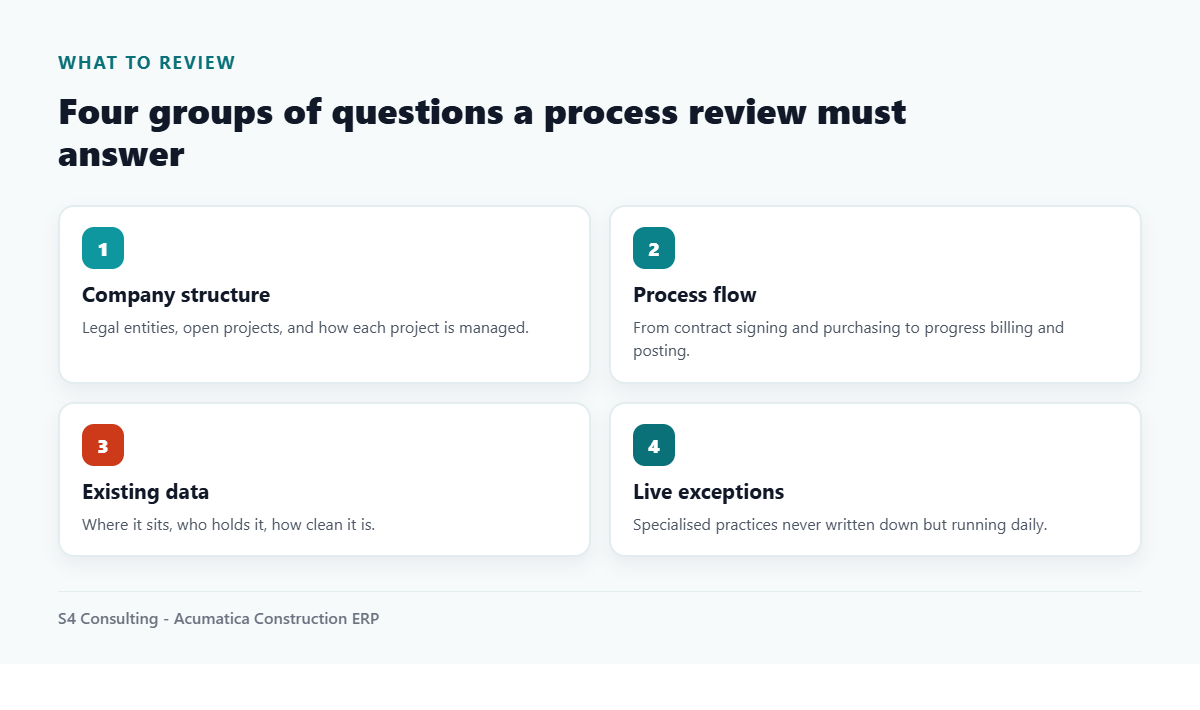
A full review answers four groups of questions. The first is structure: how many legal entities the company has, how many projects are open, and how each is managed. The second is process flow: from contract signing, material purchasing and progress billing through to revenue and cost posting. The third is data: where it sits today, who holds it, and how clean it is. The fourth is exceptions: the specialised practices that were never written down but run daily.
The fourth group is the most neglected, yet it decides how accurate the system will be. In real implementation projects, the hard part is rarely the standard processes. It is the one-off cases such as site advances, material transfers between projects, or extra work completed before a contract addendum exists.
Who needs to take part in the business process review?
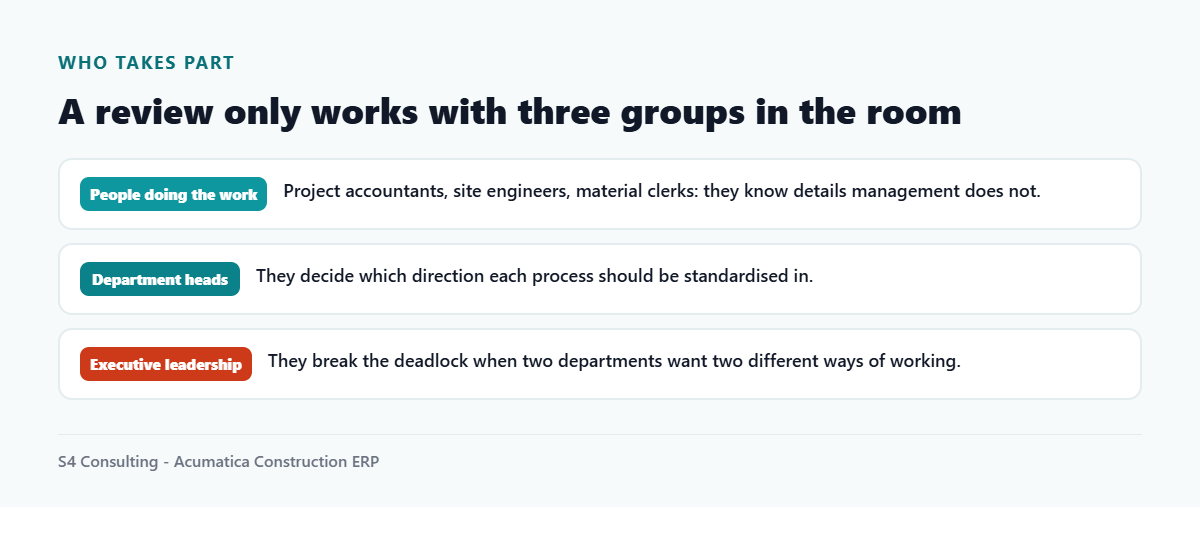
A review only works when three groups are in the room. First, the people doing the work: project accountants, site engineers and material clerks, because they know details management does not. Second, department heads, who decide which direction a process should be standardised in. Third, executive leadership, who break the deadlock when two departments want two different ways of working.
The common mistake is to interview only department heads. The resulting design reflects the process on paper rather than the process in practice, and the gap only surfaces at go-live when users behave differently.
How long should a business process review take?
For a mid-size construction company the review usually takes four to eight weeks, depending on the number of projects and the complexity of the legal entity structure. Companies running many parallel projects should split the review by process rather than by department, for example one round for project financials, one for purchasing and materials, and one for revenue and progress billing.
What should the process design contain after the review?
A usable design has four parts. Process maps for each core activity, stating who does what at which step. A list of exceptions with how each is handled in the system. A data mapping that says which legacy data moves to the new system and by which rule. And a deferred items list, signed off.
How does Acumatica Construction ERP support the review?
Acumatica Construction ERP is built around the project, so much of the review structure mirrors the system structure, which shortens design time. Three points give mid-size and large construction firms an advantage: user-based licensing is not charged per user, so every project accountant and site engineer can be brought on from the review stage without inflating licence cost; project financials are deep enough to record committed cost and forecast cost at completion; and the platform follows advanced governance practice with AI capability for repetitive data entry and reconciliation steps.
In Vietnam, S4 Consulting is a Gold Partner of Acumatica holding more than 31 global certifications. S4 localises Acumatica Construction for Vietnamese businesses through its Financial Localization suite, Vietnamese language packs, e-invoice integration, bank integration, and Excel integration with Velizo, so the accounting team keeps its spreadsheet habits while working from a single source of data.
Frequently asked questions about the ERP business process review
Can the review be skipped if processes are already standardised?
It should not be skipped, though it can be shortened. Even with standardised processes you still need to confirm how departments actually work and which exceptions exist, because the system only runs correctly when it reflects reality.
Should the review be organised by department or by process?
By process. A process such as construction material purchasing crosses several departments, so reviewing along the flow exposes bottlenecks and overlaps that a department-by-department approach tends to miss.
Will the process design change after go-live?
It will, but how much depends on the quality of the review. A good design still needs small adjustments once users work in the system daily, but it will not require rebuilding the chart of accounts or the way project codes attach to transactions, which are the costliest parts to redo.
Do you need a process review before your ERP project starts?
Talk to S4 Consulting to review your business processes and define the right scope for Acumatica Construction ERP.