


S4 eSuite · Oracle NetSuite localization for Vietnam
Actual manufacturing costs on Oracle NetSuite, the way Vietnamese accounting works.
S4 eSuite VN Actual Costing (S4-APC) is a period-end actual costing package built by S4 Consulting that runs inside Oracle NetSuite. It collects the month’s actual costs from the general ledger, allocates them to each work order and finished good, and posts the entries the way Vietnamese accountants book them. No spreadsheets outside the system, no re-keying, and a controlled monthly cost close.
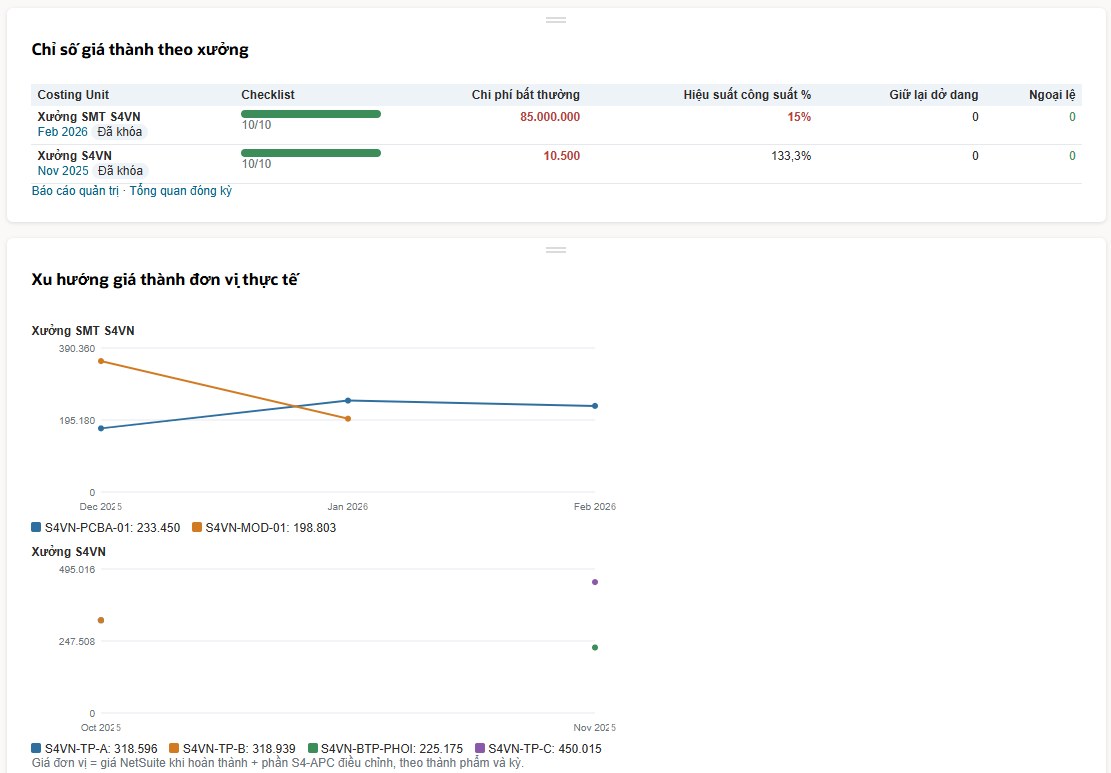
Management home page in NetSuite: cost indicators by plant, capacity utilization and actual unit cost trend (Vietnamese interface).
Two views of cost
Why do plants in Vietnam need a period-end actual cost?
Oracle NetSuite, like other global ERPs, favors immediacy: a completed work order gets a cost right away from material and cost standards, inventory always carries a value and COGS is booked at shipment. Under VAS 02, Vietnamese statutory books also need a second view: the period-end actual cost, including payroll, depreciation, electricity and every production cost of the month. Without it, companies typically face four problems.
Product costs miss the real costs of the month
Payroll, depreciation, power and overheads stay in expense accounts and never reach products. When power, wages or depreciation change, the system cost does not.
The most important part sits outside the ERP
Accountants export data to allocate overheads, value WIP and compute scrap, then key adjustments back in. It takes days, depends on one or two people and is hard to defend in an audit.
Inventory, COGS and VAS 02 drift apart
Fixed overhead of a low-volume month is pushed into inventory, abnormal scrap is buried in product cost and account 154 carries balances nobody can explain.
No one knows which products sell below cost
Margins by product, customer and invoice look better than reality, and management sees actual costs only weeks after month end.
Video
See S4-APC in under four minutes.
How S4-APC adds the VAS period-end actual cost inside Oracle NetSuite: cost pools, allocation bases, a 10-step close, automatic postings, GL reconciliation and the closing file.
Cost pools and allocation
Every plant costs differently. Configure it in NetSuite.
Accountants define cost pools: source accounts, filters by department, class or location, and whether the pool is variable or fixed. Shared costs such as plant-wide electricity are split across plants by declared percentages that must total 100%. Each pool picks one of eight allocation bases plus a fallback base when the primary base is zero.

Cost Pool tab (Vietnamese interface): line depreciation absorbed at 15% of normal capacity, the rest moved to COGS 632.
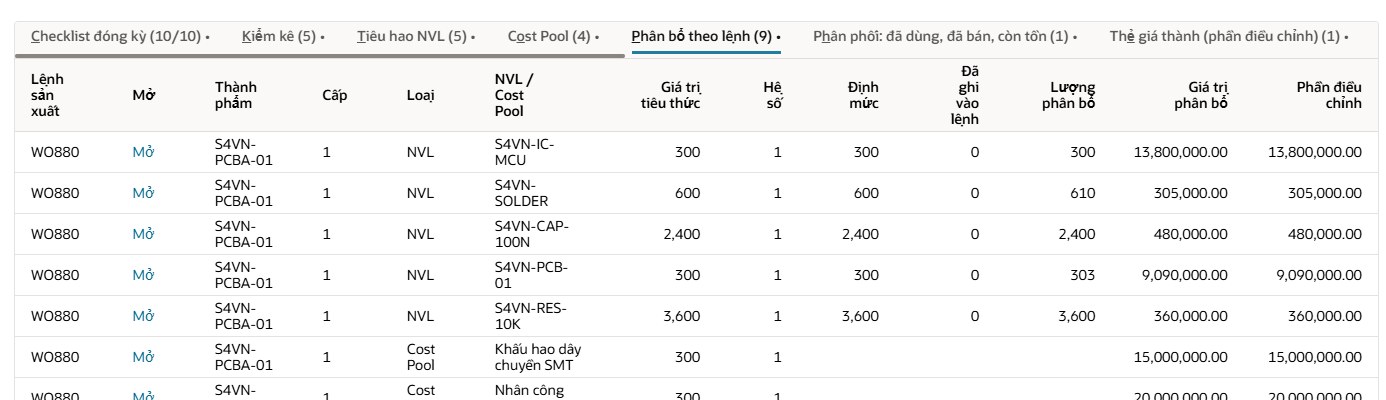
Each allocation line keeps the base value, factor and amount per work order.
Materials
Actual usage from counts, with abnormal scrap separated.
S4-APC derives actual material usage from period-end counts and compares it with BOM standards. When a full count is not available, the accountant picks one of four estimation methods. Materials can be tracked per subsidiary or per plant: issued to each work order, or allocated to work orders at period end.
- Normal loss threshold per material: usage within it goes into product cost, the excess goes to COGS 632.
- Unexplained count differences go to account 1381.
- Four estimation methods: by standard, by usage history, by cycle count, by indirect measurement.
- Other issues such as scrap are classified by account for separate reporting.
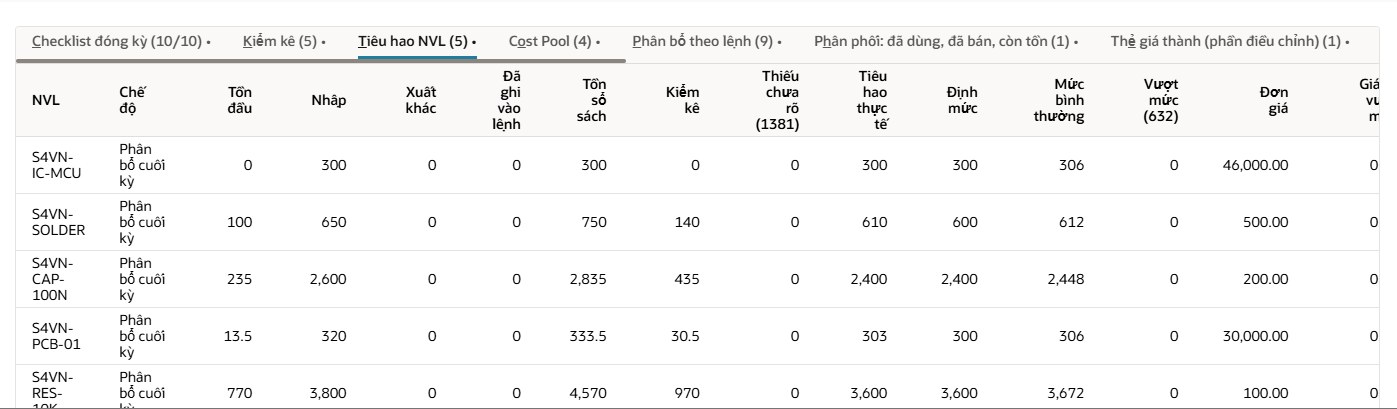
Material usage for the period: actual usage against standard and normal loss (Vietnamese interface).
Costing engine
From the month’s actual costs to the cost of each finished good.
Actual cost collection
Costs come from the NetSuite general ledger into pools for direct labor, variable overhead, fixed overhead and power. Accountants can adjust each pool before calculating.
Multi-level production
Semi-finished goods are costed first and their cost flows into the finished goods that consume them. Equivalent output includes ending WIP by percentage of completion.
Abnormal costs under VAS 02
Fixed overhead enters product cost only at normal capacity; the unabsorbed part in a low-volume month goes to COGS 632. An approver can accept an abnormal amount into cost, and every override is logged.
Work in progress
Ending WIP is valued by weighted average on percentage of completion, carried into the next period and released when the work order completes.
Cost distribution
Adjustments are split three ways: consumed as semi-finished goods, sold (COGS 632) and still in stock (revaluing finished goods 155).
Automatic postings, fully reversible
The system creates inventory adjustments, material issues, journal entries and work order closes, with lot, bin and multi-location plants. One action reverses a whole period so the books return to their prior state.
Controlled close
A 10-step checklist, segregated duties, locked periods.
- A 10-step checklist with due dates and an owner for every step.
- Pre-run checks: pending approvals, negative stock, work orders closed early, missing BOMs. Simulate results before posting.
- Automatic reconciliation of accounts 154, 621, 622 and 627 after posting, aware of shared costs that belong to other plants.
- Locked periods cannot be changed. A full activity log and a PDF closing file support the audit.
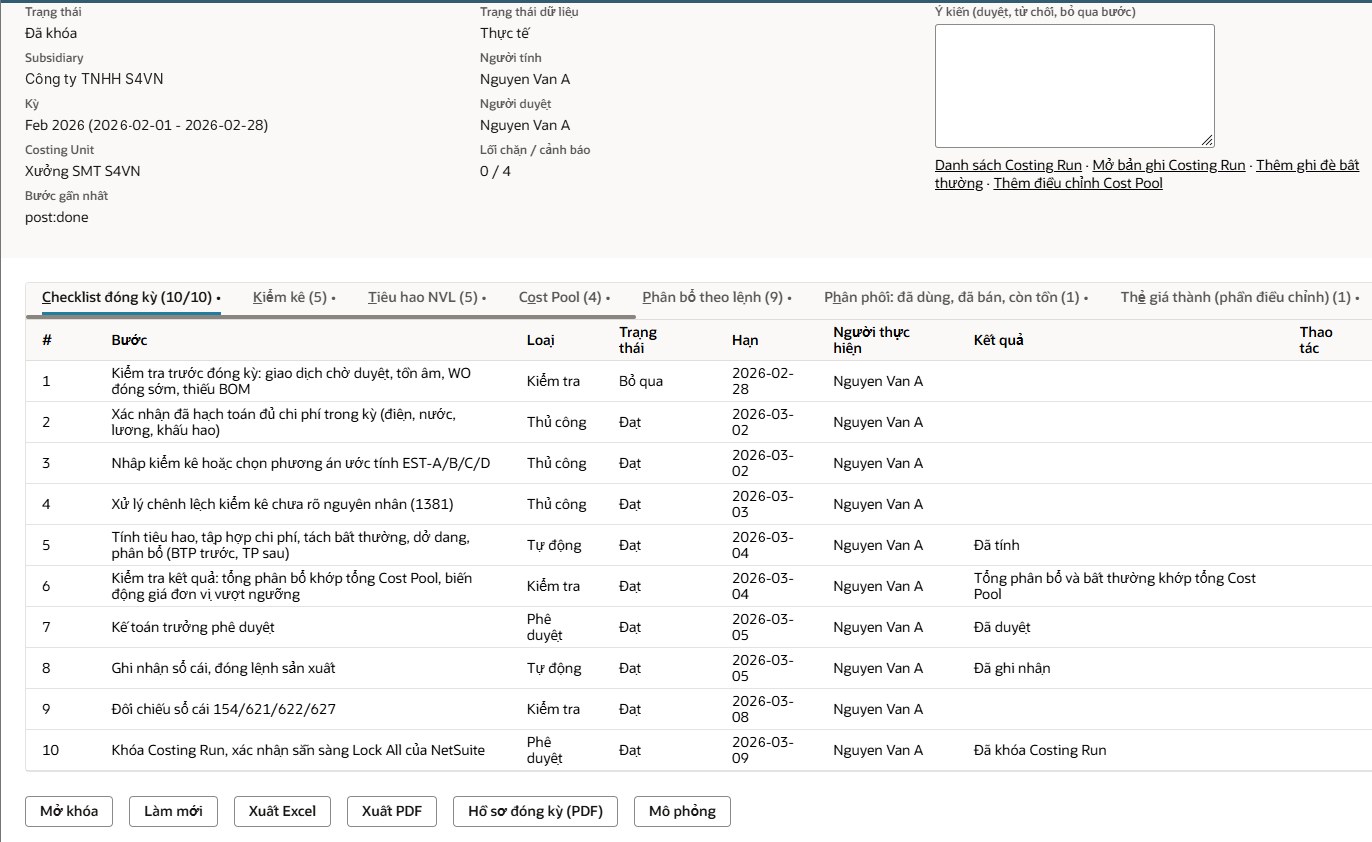
A locked costing run: 10 checklist steps with due dates, owners and results (Vietnamese interface).
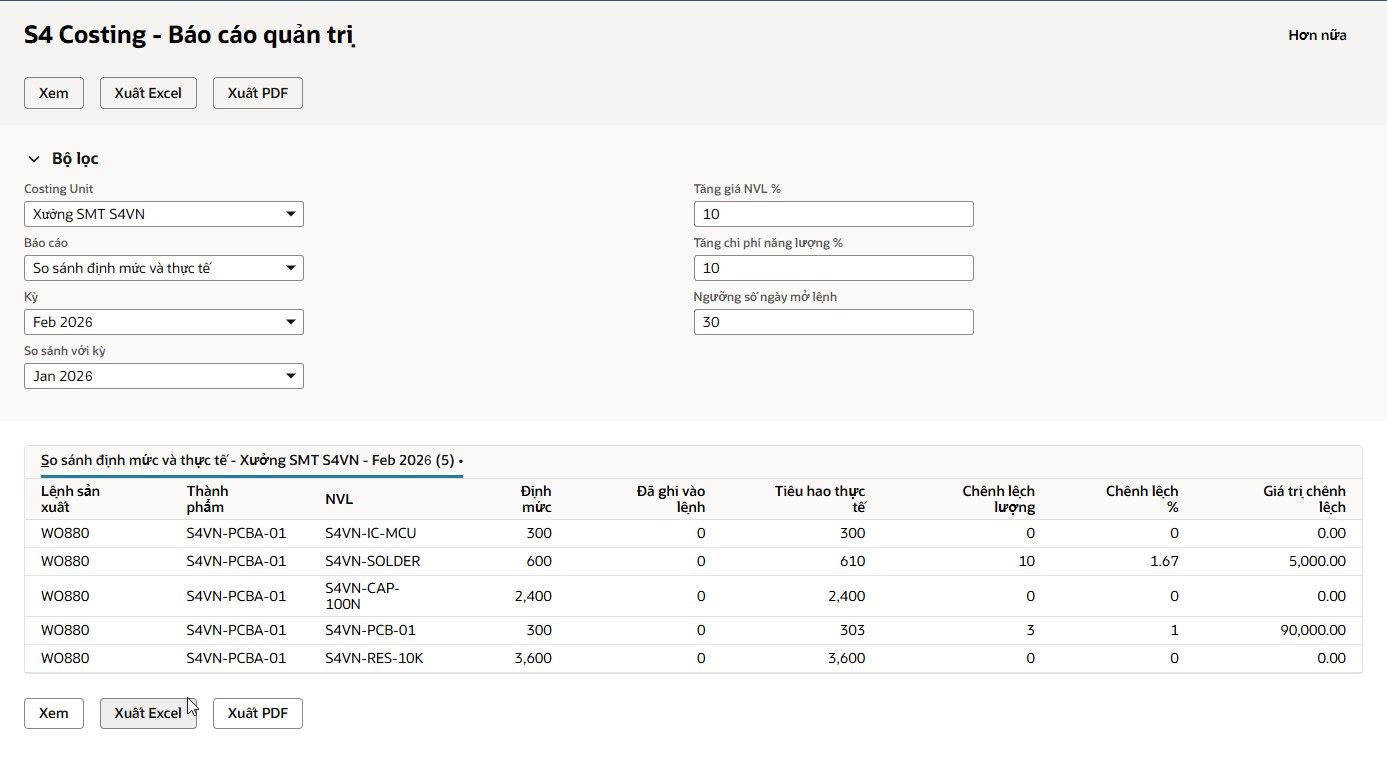
Standard vs actual report: quantity, percentage and value variances by work order and material (Vietnamese interface).
Management reporting
From cost numbers to business decisions.
18 management reports and a management dashboard show which products sell below cost, margin by invoice, which cost elements moved this month against last month and how much capacity each plant uses. Every report exports to Excel and PDF.
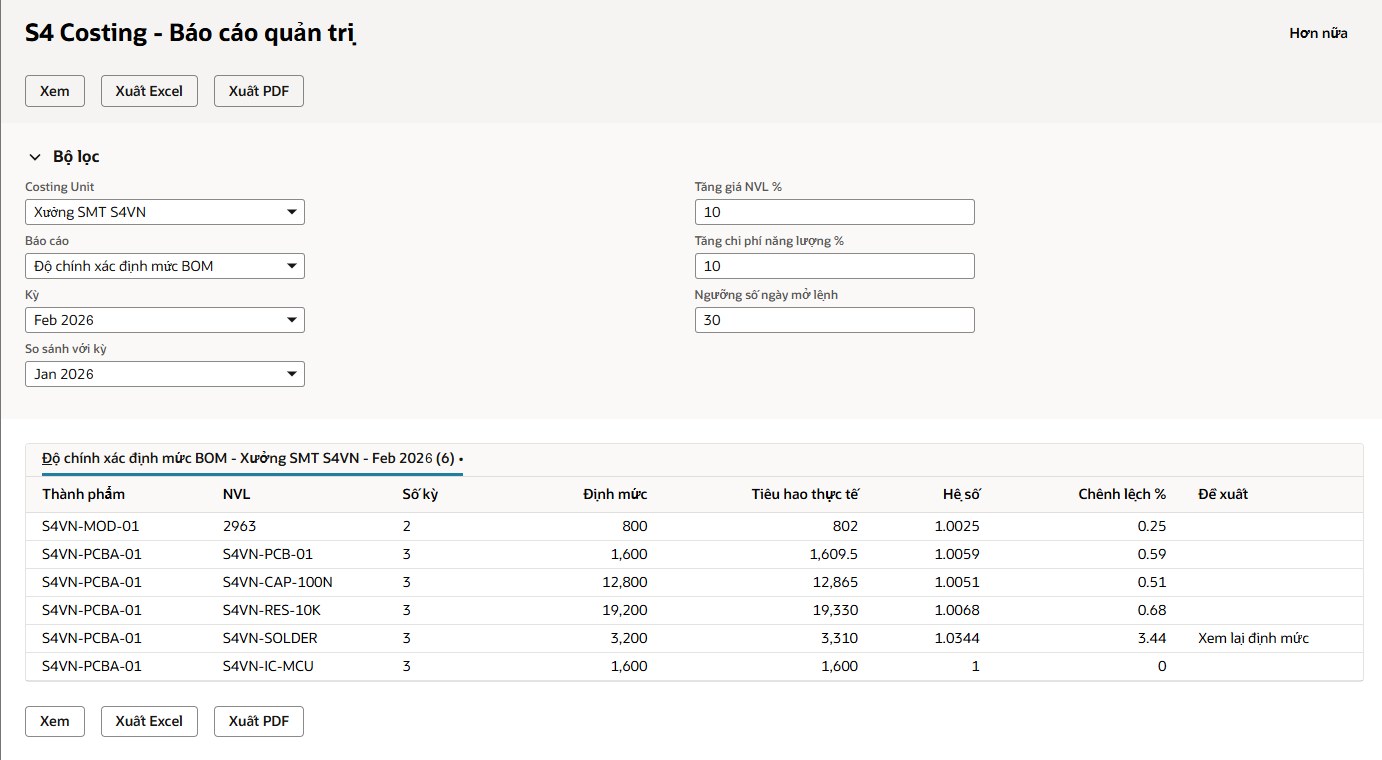
BOM accuracy with suggestions to review standards.
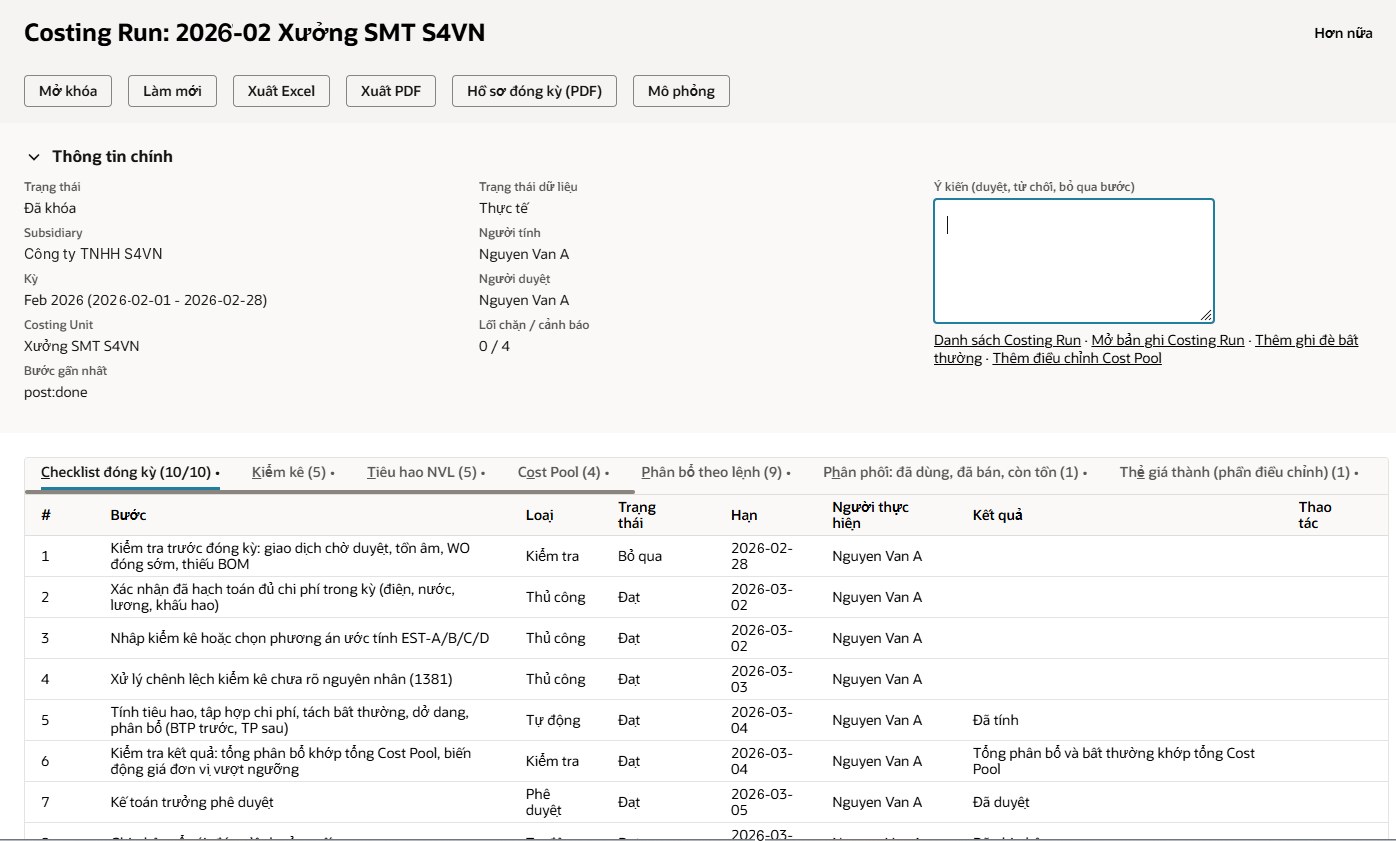
Costing run: Excel, PDF, closing file and simulation.
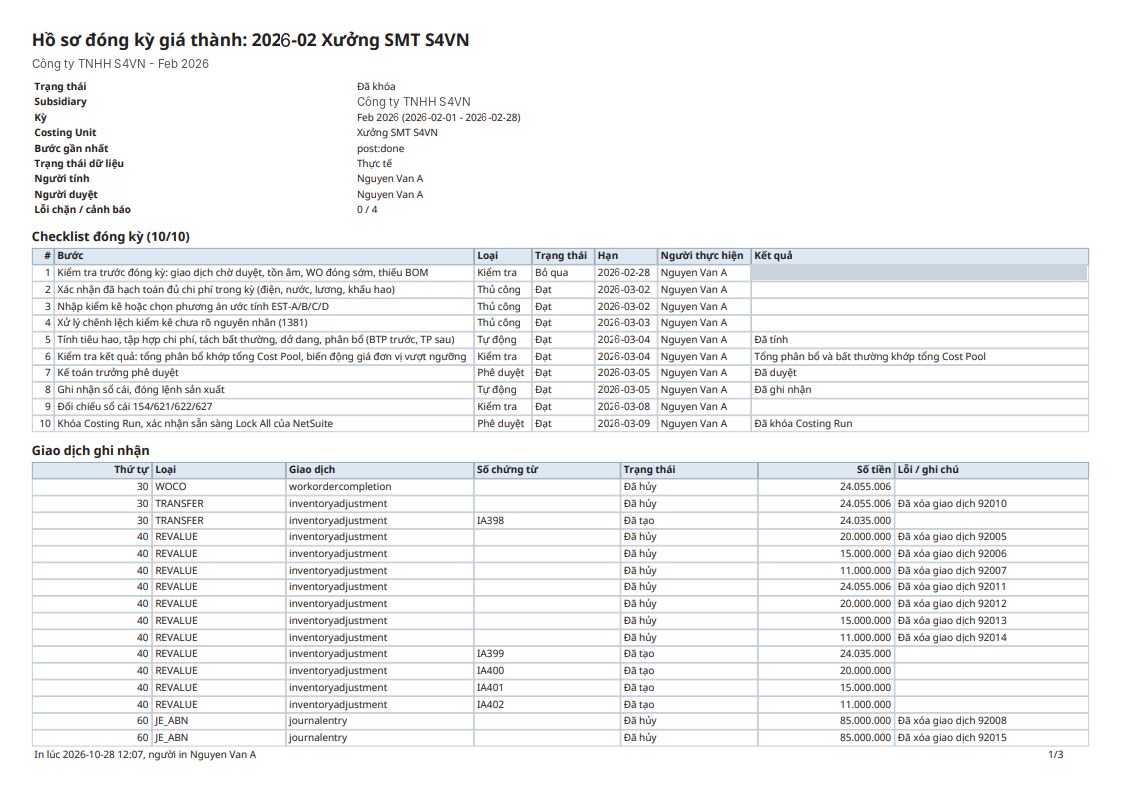
PDF closing file: checklist and posted transactions.
Standard NetSuite and S4-APC
NetSuite records production. What does S4-APC add?
S4-APC does not replace the NetSuite costing method. It runs on NetSuite’s own manufacturing transactions and fills the gaps Vietnamese manufacturers usually handle in spreadsheets. You keep your current costing method (average, FIFO…) and add one controlled step at month end.
| Area | Standard NetSuite | What S4-APC adds |
|---|---|---|
| Finished goods cost | Materials issued to the work order plus labor and overhead at predefined rates (Manufacturing Cost Template). | Actual costs of the month from the GL (payroll, depreciation, power…) allocated to each work order and finished good. |
| Manufacturing overhead | Booked to expense accounts, does not flow into product cost by itself. | Pooled and allocated on 8 bases; shared costs split across plants. |
| Low capacity | Unabsorbed fixed cost is not separated. | Fixed overhead not absorbed because output is below normal capacity goes to COGS 632, per VAS 02. |
| Material usage | Backflush standards or issued quantities; count differences to an inventory adjustment account. | Actual usage from counts or estimates; normal loss into cost, excess to 632, unexplained shortages to 1381. |
| Ending WIP | Balance of open work orders. | Weighted-average WIP valuation by percentage of completion, carried forward. |
| Sold vs in stock | COGS fixed at the cost when shipped. | Adjustments split to COGS 632 for sold goods, inventory 155 for stock on hand and semi-finished goods consumed downstream. |
| Period close | Generic financial close checklist. | Costing-specific checklist, pre-run checks, segregated preparer and approver, reversal and rerun, 154/621/622/627 reconciliation, period lock. |
| Reporting | Inventory, production and standard COGS reports. | Cost cards by element, standard vs actual, cost trends, sales below cost, cost bridge between periods, capacity utilization, dashboard. |
Standard NetSuite behavior described here reflects common configurations (Manufacturing Cost Template, Standard Costing) and may differ by release and enabled features.
Benefits by role
What does each team get?
CEO and management
- True cost and margin by product, customer and invoice for pricing and bids.
- Early warning on items sold below cost.
- Why cost moved between two periods, by cost element.
Plant director
- Capacity utilization by plant and the cost of idle capacity.
- Which materials exceed standard, on which work orders.
- Energy, scrap and BOM accuracy as a basis to update standards.
Chief accountant and cost accountant
- No more costing spreadsheets: allocation, WIP, scrap and posting run in NetSuite.
- A checklist-driven close that does not depend on one person.
- Reverse and rerun when needed; no unexplained 154 balances.
Auditors and tax
- Entries designed around VAS 02: unabsorbed fixed cost and abnormal scrap expensed in the period.
- Every number traces back: cost source, base, preparer, approver, lock time.
- A PDF closing file to archive and explain.
IT and ERP owners
- Full value from the NetSuite investment, no extra system, no integration.
- Keep the current costing method and production process.
- Roll out to new plants or subsidiaries by copying configuration.
In short
- Right cost numbers.
- A fast, controlled close.
- Decisions based on real profit.
Legal basis
Which Vietnamese rules is S4-APC designed around?
| Basis | Relevant requirement | How S4-APC responds |
|---|---|---|
| Law on Accounting 88/2015/QH13 | Truthful records backed by documents; period-end counts and book closing. | Entries generated from NetSuite GL and documents with preparer, approver and lock time; usage derived from period-end counts. |
| VAS 02 Inventories | Cost of finished goods covers direct materials, direct labor and overhead; fixed overhead allocated at normal capacity. | All three elements allocated to each work order and product; normal capacity declared per plant, unabsorbed part to 632. |
| VAS 02, costs excluded from inventory | Material, labor and other costs above normal levels. | Normal loss thresholds per material; the excess goes to 632. |
| Vietnamese accounting regime | Postings through 621, 622, 627, 154, 155, 632; unexplained shortages to 1381; ending WIP valuation. | Accounts mapped by configuration to the regime in use, including Circular 99/2025/TT-BTC; 154/621/622/627 reconciliation. |
| Corporate income tax rules on costs | Companies set and keep material usage standards as supporting evidence. | Keeps standards for each locked period, compares them with actuals and supports cost explanations with the PDF closing file. |
Fit and extensibility
Which companies is S4-APC for?
Mid-sized and large manufacturers on Oracle NetSuite
Electronics, metal, plastics, food, garment and FDI manufacturers that need VAS actual costs alongside immediate costs for group reporting, with several plants, multi-level semi-finished goods, lot-tracked items and bin locations.
Rules per subsidiary and per plant
Configuration is date-effective, key changes require approval and each costing run keeps a snapshot of the settings it used. Export, import and copy settings to new plants; a setup assistant; plug-ins for custom bases, lot or bin selection and conversion factors.
Oracle NetSuite localization
Other S4 packages on NetSuite
S4-APC runs with the S4 Vietnam localization for Oracle NetSuite.
FAQ
About S4 eSuite VN Actual Costing
Did not find your answer? Ask an S4 expert.
S4 eSuite VN Actual Costing
Know what each product costs and earns, right after close.
S4 Consulting is an Oracle NetSuite consulting firm in Vietnam. S4 consultants review your current costing approach, set up cost pools and allocation bases, and run a trial cost close with you in NetSuite.

Need a trusted ERP partner in Vietnam? Let’s discuss your project!