

What Is Oracle NetSuite? And Why Pair It With S4 eSuite (NetSuite+E)
Oracle NetSuite is Oracle’s cloud ERP platform, used by more than 44,000 businesses worldwide. This guide starts from the basics: what ERP is, which modules Oracle NetSuite includes, how pricing works and what an implementation looks like. It then explains how S4 Consulting combines Oracle NetSuite with S4 eSuite into NetSuite+E, so you can extend functionality without your per-user license bill growing at the same rate.

What is Oracle NetSuite?
Oracle NetSuite is an enterprise resource planning (ERP) system that runs entirely in the cloud, built and operated by Oracle. Instead of juggling separate tools for accounting, inventory, sales and reporting, a company runs all of these processes on one system that shares a single, real-time database.
Think of Oracle NetSuite as the central nervous system of the business. Sales enters an order, the warehouse ships it, finance records the revenue and the receivable – all in the same place. Nobody re-keys another team’s data, and leadership always looks at the same numbers.
Oracle NetSuite was founded in the United States in 1998 under the name NetLedger, one of the first business applications designed from the ground up for the internet. Oracle acquired NetSuite in 2016 for roughly USD 9.3 billion, and it has since become Oracle’s flagship cloud ERP for mid-sized and fast-growing companies.
This is why S4 Consulting uses Oracle NetSuite as the financial core of its implementations. Extensions for specific processes such as purchasing, retail and expenses are handled by S4 eSuite, forming the NetSuite+E model described in section 09.
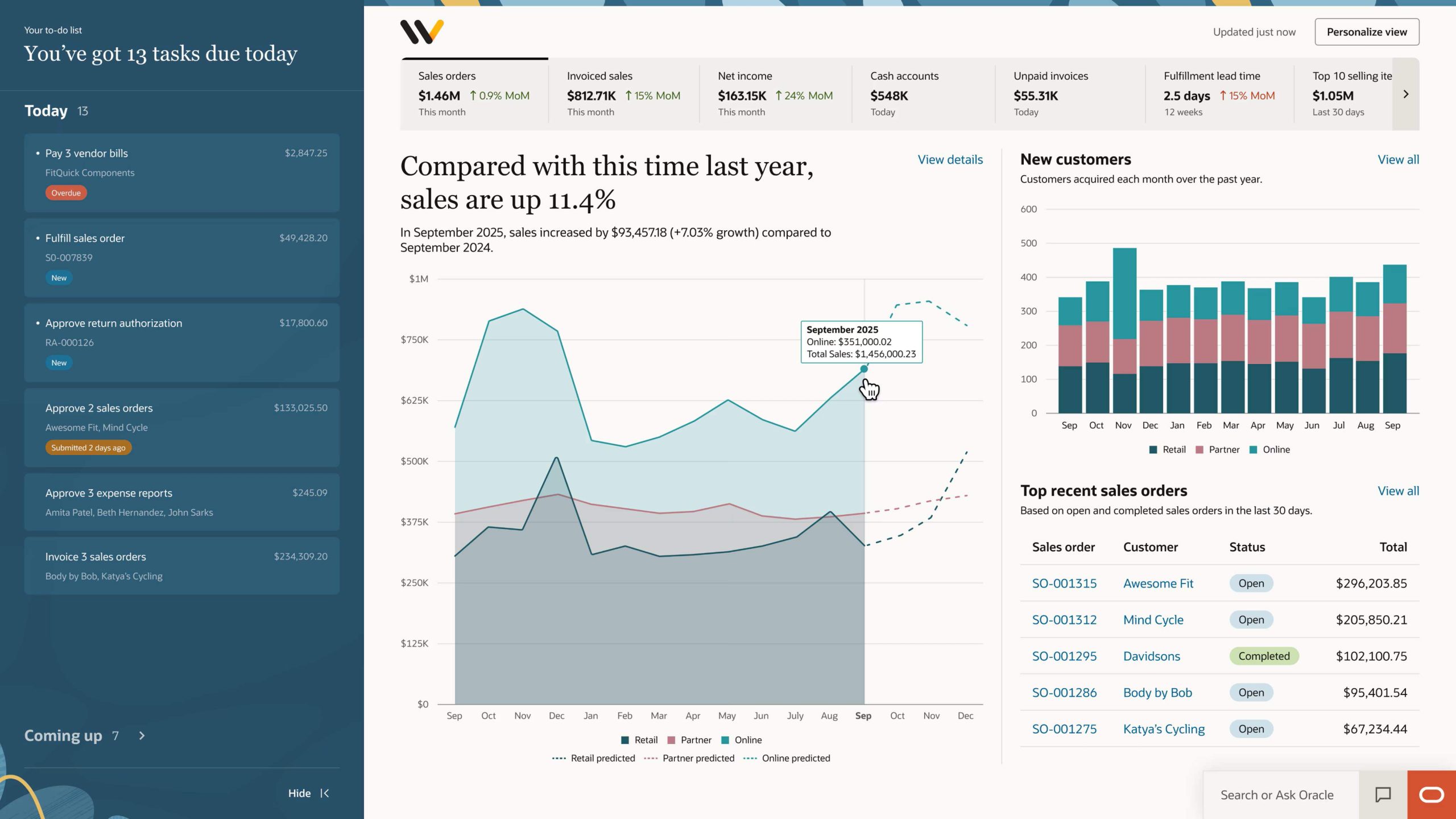
The dashboard in Oracle NetSuite Next
What problems does ERP solve?
If you are new to ERP, start with the problem. Most companies go looking for an ERP once their data is scattered across too many places.
Data lives everywhere
One system, one source of truth
Example: one sales order flowing through Oracle NetSuite
Sales Order
Sales creates the order. The system checks stock availability and the customer’s credit limit.
Item Fulfillment
The warehouse ships against the order. Inventory drops and cost of goods sold posts automatically.
Invoice
Finance bills from the order. Revenue and accounts receivable are recorded.
Customer Payment
The payment is recorded and applied to the right invoice.
Reporting
Revenue, gross margin, receivables and inventory update on the dashboard straight away.
Each step is created from the one before it, so data is entered only once. From any report, users can drill down to the original transaction.
How does cloud ERP work?
Oracle NetSuite is delivered as SaaS (Software as a Service). You subscribe and use it over the internet, while Oracle runs all the infrastructure behind it.
No servers to buy
Oracle runs the platform on Oracle Cloud Infrastructure (OCI). You don’t invest in servers or handle backups and hardware maintenance.
Access from anywhere
Work in a web browser or the mobile app – a good fit for multi-site businesses and teams that travel.
Automatic updates twice a year
Every customer runs the latest version. You avoid the costly upgrade projects that come with on-premise ERP.
Subscription pricing
You pay annually, so the upfront investment is lower than buying perpetual licenses plus servers and an in-house IT team to run them.
Customization on SuiteCloud
Add fields, forms and workflows, or write SuiteScript for your own processes. These customizations carry forward when Oracle releases a new version.
Scales as you grow
Start with financials, then add users, modules or subsidiaries as the business grows – without replacing the system.
Core modules of Oracle NetSuite
Oracle NetSuite is modular. The Core ERP package already covers the basic finance, order-to-cash and procure-to-pay processes. Specialized areas such as manufacturing or advanced warehousing are added when you need them. For a module-by-module walkthrough in Vietnamese, see Oracle NetSuite ERP là gì? Tất tần tật về Cloud ERP này on SuiteSuccess.vn.
Financial Management
General ledger, accounts receivable and payable, cash and banking, financial statements.
- Core ERP (required)
- Oracle NetSuite OneWorld: multi-entity, multi-currency, consolidation
- Fixed Asset Management
Order Management & CRM
The order-to-cash cycle: quotes, sales orders, shipping, invoicing and collections.
- Order to Cash included in Core
- CRM+: Sales Force Automation, Customer Support
Inventory & Supply Chain
Procure-to-pay and inventory management, from basic to advanced.
- Procure to Pay included in Core
- Procurement, Demand Planning
- Advanced Inventory, Oracle NetSuite WMS
Manufacturing
Production management, not included in Core.
- Work Orders & Assemblies
- Manufacturing WIP & Routings
- Quality Management
Project & Job Costing
Manage projects by task and milestone, with job costing tied directly to the financials.
- Time and expense tracking
- Estimated vs Actual comparison
Reporting & Analytics
Real-time reporting, with no waiting for period-end.
- Role-based dashboards
- Saved Searches, SuiteAnalytics Workbook
- Drill-down to source transactions
First-time buyers often assume they must license every module on day one. In practice, pick the modules that solve your priorities for the next 12-24 months and expand from there. It keeps the initial investment lower and gets you to go-live sooner.
Oracle NetSuite vs accounting software and legacy ERP
These three types of software are often confused. The table below shows the differences at a glance.
| Criteria | Accounting software | Legacy on-premise ERP | Oracle NetSuite (Cloud ERP) |
|---|---|---|---|
| Platform | Installed on a PC or local server | Installed on company servers | Cloud native, runs in the browser |
| Scope | Mainly accounting and tax | Multiple modules | End-to-end: finance, sales, purchasing, inventory, manufacturing, CRM |
| Data | Re-keyed from other departments | Centralized, but often needs extra integration | One database for the whole business |
| Reporting | By period, after closing | Usually delayed | Real time, with drill-down to transactions |
| Multi-entity, multi-currency | Limited | Available, at high cost | Available with Oracle NetSuite OneWorld |
| Version upgrades | Vendor dependent | Separate, expensive projects | Automatic, twice a year |
| Upfront cost | Low | High (licenses, servers, IT) | Moderate, paid as an annual subscription |
| International standards | Low | Depends on the system | High, suited to reporting to a foreign parent |
Note: accounting software remains a sensible choice for small businesses with simple operations. ERP pays off once you have multiple departments and processes that need to connect.
Who is Oracle NetSuite for?
Oracle NetSuite is strongest for growing companies with multiple locations or international operations. Use the signs below to assess your own business.
Signs you are ready
When to wait
In these cases, start by standardizing processes and data. When you do move to ERP, the project will be faster and less risky.
What does Oracle NetSuite cost?
There is no single price list that fits every company. Your total cost is built from the components below, depending on your size and scope.
Base platform (Core ERP)
The mandatory subscription for the core system, which includes the Standard service tier.
Service Tier
The service level (Standard, Premium, Enterprise, Ultimate) sets limits on users, file storage and monthly transaction lines. For example, Standard allows up to 100 users, 100 GB of storage and 200,000 transaction lines per month.
User licenses
Charged per user, depending on the access type. This is usually the fastest-growing cost as the business scales.
Add-on modules
OneWorld, Manufacturing, WMS, Advanced Inventory, CRM+ and more – bought only when you actually need them.
Implementation & support
A one-off consulting fee paid to the implementation partner, plus post go-live support. In S4’s experience, implementation typically runs 1-2x the first-year license cost.
Third-party SuiteApps
Extra applications from SuiteApp.com for specialized needs, usually with their own subscription fee.
Common user license types
| License type | What it is for |
|---|---|
| General Access User | Full role-based access: accounting, purchasing, sales, inventory and more |
| Specialized WMS User | Mobile warehouse tasks only: receiving, picking, packing, cycle counts |
| Specialized View & Approve | View and approve only – purchase requests, expenses, workflows (sold in packs of 5) |
| MES User | Barcode scanning and work order completion on the shop floor (minimum 5 users) |
| Employee Self-Service | Employees submit their own expense reports and timesheets (sold in packs of 5) |
Each license type comes with its own price and permission limits. To learn how Oracle counts Monthly Transaction Lines and Service Tiers, see our Oracle NetSuite Cost Optimization guide (in Vietnamese).
Estimated implementation services by project size
| Project size | Users | Scope | Implementation hours | Estimated services cost |
|---|---|---|---|---|
| Basic | 5-15 | 2-3 modules | 500-800 hours | USD 20,000-32,000 |
| Mid-size | 15-30 | 3-5 modules | 1,000-1,200 hours | USD 40,000-48,000 |
| Advanced | 30-50 | 5+ modules | 1,500-2,000 hours | USD 60,000-80,000 |
| Enterprise | 50+ | All modules | 2,000+ hours | USD 80,000+ |
Based on a reference rate of USD 40/hour, excluding licenses and custom development. Multi-entity projects need roughly 15-20% more time. For the detailed calculation, read how to estimate Oracle NetSuite implementation costs in Vietnam (in Vietnamese).
In many companies, the people who only need to raise purchase requests, submit expenses, sell at the counter or approve budgets far outnumber the finance team. License all of them and the subscription grows with headcount. That is the problem S4 solves with the NetSuite+E model below.
What is Oracle NetSuite missing in Vietnam?
Oracle NetSuite is built to a global standard. Companies operating in Vietnam typically run into the four gaps below. It pays to know them upfront so they are built into your plan and budget.
VAS reporting
No ready-made financial statements or statutory ledgers under Circular 99/2025 or Circular 133/2016.
Vietnam e-invoicing
No built-in connection to local e-invoice providers.
Manual data entry
Vendor invoices and bank statements are still keyed in by hand or imported from files.
Licenses scale with headcount
Even staff who only raise purchase requests or approve spending need their own Oracle NetSuite license.
S4 eSuite packages that close the localization gaps
S4 eSuite Localization
Vietnamese Accounting Standards (VAS) with a set of 12 statutory reports and ledgers. Subsidiaries of multinational groups keep the parent’s chart of accounts and produce VAS reports through Account Mapping.
See the localization package →S4 eSuite AR e-Invoice
Issue sales e-invoices directly from Oracle NetSuite. S4 already connects to providers such as VNPT, Viettel and BKAV, and can integrate other providers on request.
See the e-invoice package →S4 eSuite AP Automation
Pull vendor invoices straight from the tax authority into Oracle NetSuite, cutting manual entry and errors for the AP team.
See the AP Automation package →S4 eSuite Bank Integration
Connect Oracle NetSuite with Vietnamese banks such as ACB and Vietcombank. S4 can also integrate the other banks you work with.
See the bank integration package →Each S4 eSuite package has a defined scope and runs directly on Oracle NetSuite data. Added to a live Oracle NetSuite account, a package typically takes 4 to 8 weeks depending on scope and customization. Gap 04, licensing, is addressed by the NetSuite+E model in the next section. For the full overview, visit S4 eSuite for Oracle NetSuite in Vietnam.
What is NetSuite+E?
NetSuite+E is S4 Consulting’s name for combining Oracle NetSuite (the financial core) with S4 eSuite – extension modules built by S4 and connected directly to Oracle NetSuite. You extend functionality to more people without paying an extra Oracle NetSuite license for each of them.
Standard Oracle NetSuite only
Oracle NetSuite + S4 eSuite
S4 eSuite packages that save on user licenses
S4 eSuite Procurement
Digitize purchase requests, budget checks, RFQs, purchase orders and vendor invoice processing, connected directly to Oracle NetSuite.
See the Procurement package →S4 eSuite Budgeting
Build budgets by account, cost center or project, with automatic warnings or hard stops on transactions that exceed budget.
See the Budgeting package →S4 eSuite Expenses
Digitize travel requests, cash advances and expense claims for every employee, with no extra Oracle NetSuite user fees.
See the Expenses package →S4 eSuite Point of Sale
Counter sales that sync inventory and revenue back to Oracle NetSuite, with no Oracle NetSuite license needed for each cashier.
What does an Oracle NetSuite implementation involve?
An Oracle NetSuite project usually moves through six phases. S4 follows Oracle’s SuiteSuccess methodology – pre-built, industry-specific configurations and processes – to shorten timelines and reduce risk.
Discovery & assessment
Review current (as-is) processes, management goals and project scope. Confirm the module list and user count.
Solution design
Design the future (to-be) processes on SuiteSuccess best practices and identify what needs customization and localization.
Configuration & development
Set up the chart of accounts, subsidiaries, roles, workflows, print templates and required integrations.
Data migration
Cleanse and load master data (customers, vendors, items) and opening balances into Oracle NetSuite.
Testing & training
Users run real business scenarios in user acceptance testing (UAT), and issues are fixed before go-live.
Go-live & support
Switch to live operations, get support through the first month-end close and keep optimizing afterwards.
How should you prepare?
- Review each department’s current (as-is) processes
- Clean up accounting and master data
- Define management goals and the reports leadership needs
- Phase the scope, starting with the most critical processes
- Appoint a project owner and key users in each department
What drives the timeline?
- Size: a standard 20-50 user project usually takes 4-6 months
- Number of modules and subsidiaries (multi-entity adds roughly 15-20% more time)
- Level of customization and Vietnam localization
- Number of integrations with other systems (POS, marketplaces, banks…)
- Quality of your existing data
- How available your internal team is to take part
Oracle NetSuite in practice: LifeWear Technologies Vietnam
A real Oracle NetSuite implementation in Vietnam, delivered by S4 Consulting.
S4 Consulting implemented Oracle NetSuite for LifeWear Technologies Vietnam, giving this US-market manufacturer a unified operating platform, real-time visibility and tighter control over its supply chain and production.
“The S4 team demonstrated exceptional professionalism and dedication throughout the project. Even with the complexity of a manufacturing environment, they explained every detail clearly and patiently supported each end user. It felt like a true partnership rather than just a service provider.”

Why Oracle NetSuite is a trusted choice
NetSuite+E keeps Oracle NetSuite as the financial core, so it inherits the reliability and scale of the underlying platform.
Source: Oracle NetSuite’s “Why NetSuite” page.
Oracle NetSuite Next is the latest generation of Oracle NetSuite, adding Ask Oracle (a conversational AI assistant) and AI agents that automate work on the existing platform. You use these features inside the same system, with no separate product to buy. NetSuite+E is designed to stay compatible, so you are ready to use the AI capabilities when you upgrade.
Oracle NetSuite glossary for beginners
Terms you will hear often from implementation partners and in Oracle’s documentation.
- ERP
- Enterprise Resource Planning – a system that connects finance, sales, purchasing, inventory and manufacturing on one platform.
- Cloud ERP / SaaS
- ERP that runs on the vendor’s cloud infrastructure; you subscribe and access it over the internet.
- Core ERP
- The mandatory base package of Oracle NetSuite, covering financials plus basic order-to-cash and procure-to-pay.
- OneWorld
- The module for multi-entity businesses: multi-currency, multi-country and consolidated reporting.
- Subsidiary
- A legal entity in the system. Each subsidiary has its own books, currency and tax setup.
- SuiteSuccess
- Oracle’s implementation methodology, with pre-built industry configurations, reports and processes that speed up go-live.
- SuiteCloud / SuiteScript
- Oracle NetSuite’s customization platform. SuiteScript is its JavaScript-based scripting language for adding functionality.
- SuiteApp
- An extension installed on top of Oracle NetSuite, built by Oracle or a partner.
- Saved Search
- A tool for building custom reports and lists right in the interface, no coding required.
- Service Tier
- The service level that caps users, file storage and monthly transaction lines.
- UAT
- User Acceptance Testing – the phase where users test the system with real scenarios before go-live.
- Go-live
- The day the business officially starts running on the new system.
The strongest Oracle NetSuite community in Vietnam
New to Oracle NetSuite? These two channels take you from the fundamentals to real-world implementation experience, alongside Oracle NetSuite users and experts in Vietnam. Content is primarily in Vietnamese.

Lac Pham
Principal Consultant & CEO, S4 Consulting
Leader of the Oracle NetSuite Vietnam community
The first person to earn the SuiteSuccess Global Editions Alignment Excellence certification awarded by Oracle NetSuite.
Expert blog
SuiteSuccess.vn
A library of 200+ in-depth articles on Oracle NetSuite: modules, licensing, Service Tiers, localization, and lessons from implementation and daily operations.
Read SuiteSuccess.vn →Facebook community
Oracle NetSuite Vietnam
A group of 400+ members where Oracle NetSuite users, accountants, IT teams and consultants ask questions, share experience and follow the latest news from Oracle.
Join the Facebook group →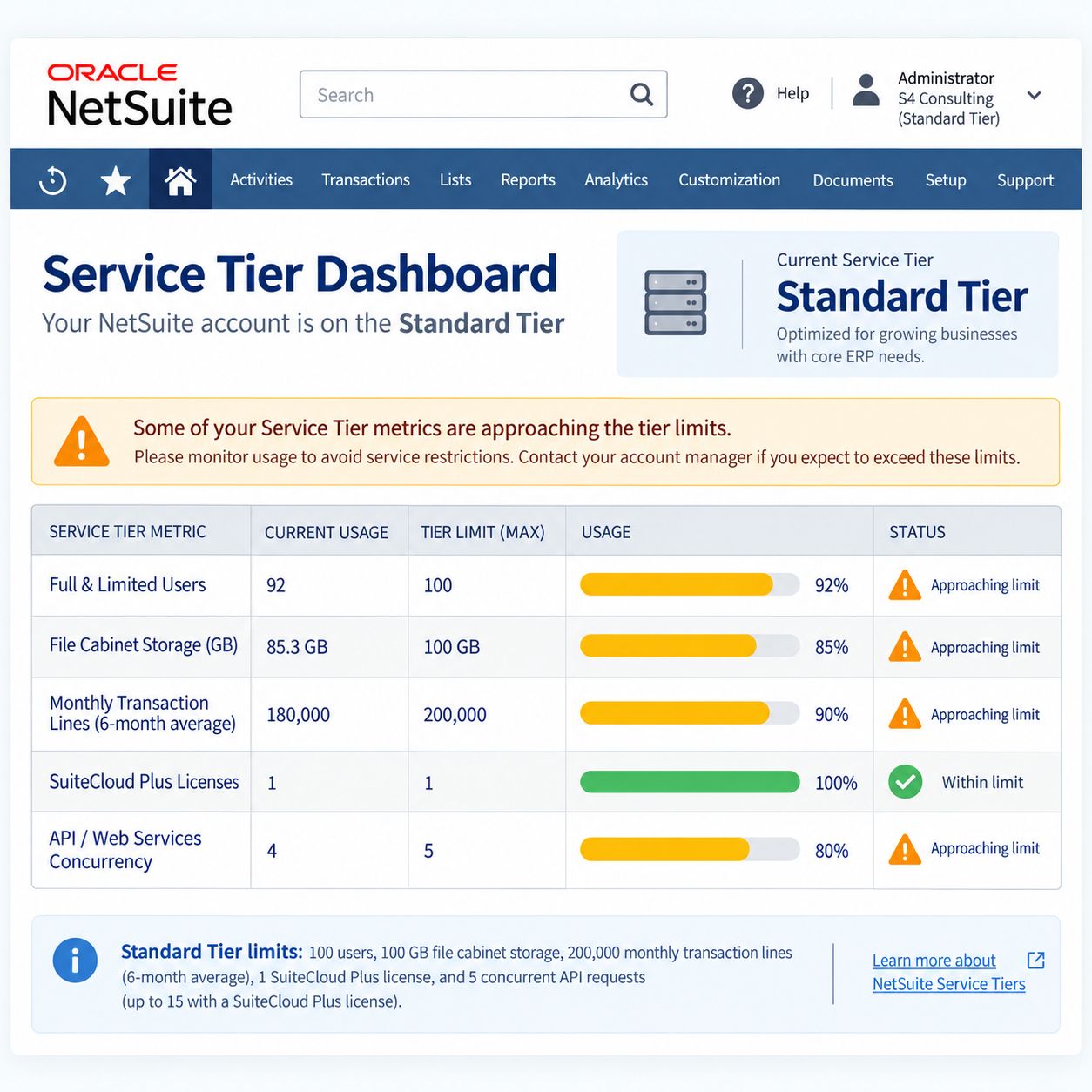
Oracle NetSuite Cost Optimization
A 10-page guide for CEOs, CFOs and CIOs: review three areas of Oracle NetSuite spend – user licenses, transaction limits and system architecture – before every renewal. Available in Vietnamese.
Download the free guide →Rolling out NetSuite+E in Vietnam
S4 Consulting is an Oracle NetSuite implementation partner in Vietnam and builds the S4 eSuite ecosystem behind NetSuite+E. You extend functionality while keeping total cost of ownership (TCO) under control, and meet Vietnam’s accounting and e-invoicing requirements.
FAQ about Oracle NetSuite & NetSuite+E
What is Oracle NetSuite?
Oracle NetSuite is a cloud-based enterprise resource planning (ERP) system from Oracle. It brings finance and accounting, sales, purchasing, inventory, CRM and reporting together on one database, so the business runs and makes decisions from a single source of truth.
How is Oracle NetSuite different from accounting software?
Accounting software mainly records financial transactions after they happen. Oracle NetSuite also manages the processes that create them: orders, purchasing, inventory and production. Journal entries are generated automatically from those processes, so numbers match across departments and reports are available in real time.
What size of company should use Oracle NetSuite?
Oracle NetSuite fits mid-sized and fast-growing companies best, especially those with multiple branches or subsidiaries, or subsidiaries of foreign groups that report under international standards. Very small businesses with simple operations can start with accounting software.
Do I need to buy servers to run Oracle NetSuite?
No. Oracle NetSuite is a cloud ERP, and Oracle runs all the infrastructure on Oracle Cloud Infrastructure. You only need a computer with a web browser and an internet connection, or the mobile app.
Does Oracle NetSuite support Vietnamese Accounting Standards (VAS) and e-invoicing?
Oracle NetSuite is a global system that supports multiple accounting standards. Vietnam-specific requirements such as VAS financial statements, e-invoicing and local bank connections usually need a localization layer. Standard Oracle NetSuite has no ready-made reports under Circular 99/2025 or 133/2016 and no connection to local e-invoice providers. S4 eSuite fills these gaps with its Localization, AR e-Invoice, AP Automation and Bank Integration packages, and can connect to the e-invoice provider or bank of your choice.
What is NetSuite+E and how does it differ from standard Oracle NetSuite?
NetSuite+E combines Oracle NetSuite (the financial core) with S4 eSuite (extension modules built by S4 Consulting and connected directly to Oracle NetSuite). The key difference: S4 eSuite serves users who don’t work directly in Oracle NetSuite, without additional Oracle NetSuite per-user license fees, which significantly lowers total cost as your user count grows.
Which modules does S4 eSuite include?
S4 eSuite includes Procurement, Point of Sale, Expense Management, Budgeting, AP Bill Automation and the Vietnam localization packages (VAS accounting, e-invoicing, bank integration). All of them sync data back to the Oracle NetSuite financial core.
Why pair Oracle NetSuite with S4 eSuite instead of buying more licenses?
Oracle offers lower-cost license types such as Employee Self-Service and View & Approve, but each comes with functional limits. For processes like purchase requests, counter sales or detailed budget control, S4 eSuite provides full business screens outside the Oracle NetSuite license layer, while data still syncs to the financial core. You can add users without your license costs rising in step.
How long does an Oracle NetSuite and NetSuite+E implementation take?
A standard project for 20 to 50 users usually takes around 4-6 months. Multi-entity projects need roughly 15-20% more time. The actual timeline also depends on the number of modules, localization requirements, integrations and the quality of your existing data. S4 follows the SuiteSuccess methodology and phases the scope, so you go live early with your most critical processes and expand from there. Contact S4 for a timeline based on your actual scope.
How is the cost of Oracle NetSuite and NetSuite+E calculated?
Oracle NetSuite costs include the Core ERP base package, the Service Tier, user licenses by type, add-on modules and implementation fees. Implementation typically runs 1-2x the first-year license cost – see the detailed breakdown in estimating Oracle NetSuite implementation costs (in Vietnamese). With NetSuite+E, you also pay for the S4 eSuite modules you use, but no Oracle NetSuite license is needed for S4 eSuite users. Contact S4 Consulting for a quote sized to your business.
Should I choose Oracle NetSuite or Acumatica?
Both are cloud ERPs. Oracle NetSuite is strong for multinational companies, multi-entity groups and subsidiaries of foreign parents. Acumatica charges by resource usage rather than by user, which suits businesses with many users such as manufacturers, construction firms and distributors. S4 Consulting implements both platforms, so we can advise on the right fit for your actual needs.
Ready to Optimize Your ERP Costs With NetSuite+E?
S4 Consulting – Oracle NetSuite implementation partner in Vietnam and developer of the S4 eSuite ecosystem.
Get a free consultation →
Need a trusted ERP partner in Vietnam? Let’s discuss your project!