



Nucleus Research 2026: 4 ERP Platforms to Shortlist for 2027
What does the Nucleus Research 2026 ERP report say?
The Nucleus Research 2026 ERP report shows that ERP is moving beyond traditional financial management toward a broader platform for running the enterprise. Businesses are increasingly looking for automation, real-time data, scalability and operational visibility rather than simply adding more accounting functions.
The SMB ERP Technology Value Matrix 2026, published by Nucleus Research in June 2026, examines ERP platforms serving small and midsized businesses. The report highlights a common challenge: companies are managing increasingly complex operations while trying to avoid proportional increases in administrative workload and headcount.
This makes modern ERP evaluation different from previous software selection projects. Finance remains the foundation, but companies also need to consider inventory, procurement, manufacturing, sales, supply chain, projects, analytics and data management as part of the same business architecture.
Why should CIOs in Vietnam look at Nucleus Research when planning ERP for 2027?
Nucleus Research provides an independent reference point for building an ERP shortlist before moving into software demonstrations, RFPs and implementation partner discussions. Its Value Matrix evaluates vendors based on the value delivered through functionality and usability rather than simply counting the number of features in each platform.
The 2026 report also takes a practical view of AI. Instead of treating AI as a standalone technology experiment, Nucleus Research highlights use cases such as reducing repetitive work, simplifying reporting, identifying anomalies and improving business responsiveness. AI is therefore evaluated as part of a broader ERP environment covering automation, data and operational efficiency.
For Vietnamese companies preparing their 2027 technology budgets, this perspective is useful because ERP selection should not start with the question, “How many modules does the software have?” A more important question is whether the platform can help the company operate more efficiently, scale without proportionally increasing its administrative structure and turn operational data into better decisions.
Which ERP platforms are included in the Nucleus Research 2026 Value Matrix?
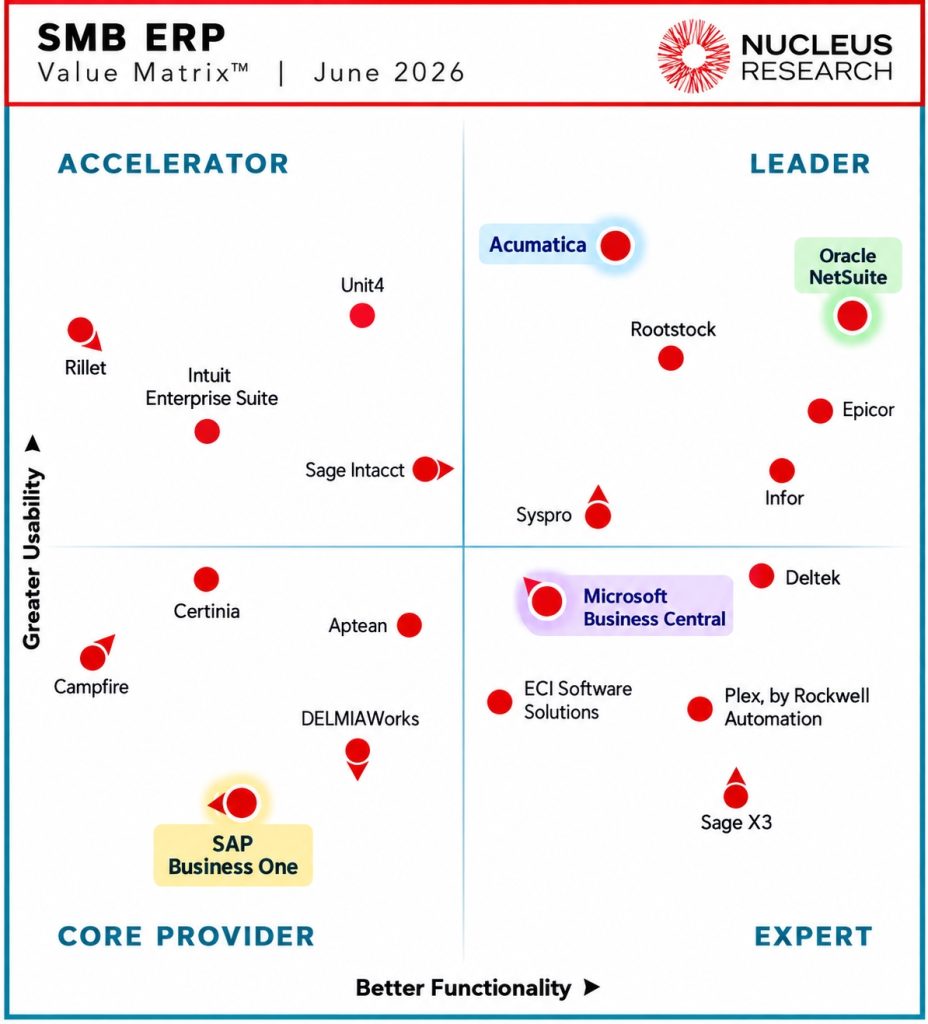
Nucleus Research divides vendors in the 2026 Value Matrix into four groups: Leaders, Experts, Accelerators and Core Providers. These categories represent the position of vendors according to the Nucleus Research methodology. They should not be interpreted as a ranking from number one to number four.
- Leaders: Acumatica, Epicor, Infor, Oracle NetSuite, Rootstock and Syspro.
- Experts: Deltek, ECI Solutions, Microsoft Business Central, Plex by Rockwell Automation and Sage X3.
- Accelerators: Intuit Enterprise Suite, Rillet, Sage Intacct and Unit4.
- Core Providers: Aptean, Campfire, Certinia, DELMIAWorks and SAP Business One.
According to Nucleus Research, Leaders combine strong functionality and usability, while Experts provide functional depth for more complex requirements. Accelerators focus on usability and deployment speed, while Core Providers deliver essential ERP capabilities for more straightforward requirements.
For a Vietnamese company planning an ERP project for 2027, the practical value is therefore not finding a single “number one ERP.” The objective is to identify which platforms fit the company’s operating model, industry, size and growth plans.
Why should Acumatica be included in an ERP shortlist for 2027?
Acumatica is classified as a Leader in the Nucleus Research 2026 SMB ERP Technology Value Matrix. The report describes Acumatica as a Cloud ERP platform for growing organizations, with editions covering industries such as manufacturing, distribution, construction, retail/e-commerce and professional services.
One feature that deserves attention from Vietnamese companies is Acumatica’s licensing model. Nucleus Research describes Acumatica as using a consumption-based licensing model that allows unlimited users, with the platform scaling according to transaction and resource consumption rather than the number of employees or users.
This becomes relevant when calculating ERP total cost of ownership. A company with many employees participating in sales, warehouse, purchasing, manufacturing, accounting or project management needs to look beyond the initial software quotation and understand how costs will change as the organization grows.
Oracle NetSuite vs Acumatica:
Which Cloud ERP Fits Your Business?
See how S4 implements Oracle NetSuite and Acumatica for each industry in Vietnam.
How does Oracle NetSuite fit companies that are expanding?
Oracle NetSuite is also classified as a Leader in the Nucleus Research 2026 Value Matrix. The report describes NetSuite as a unified Cloud ERP built around a centralized data model covering financials, billing, revenue recognition, budgeting, professional services automation, supply chain, manufacturing, WMS, CRM, commerce and business intelligence.
NetSuite is particularly relevant when a company has more demanding financial management requirements or operates across multiple entities and markets. Nucleus Research notes that NetSuite supports multi-entity, multi-currency and global tax requirements across more than 220 countries and territories.
For Vietnamese companies expanding through subsidiaries, overseas operations or more complex corporate structures, these capabilities are important criteria to evaluate during an ERP selection process.
Where does Microsoft Business Central sit in the 2026 Value Matrix?
Microsoft Business Central is classified as an Expert in the Nucleus Research 2026 Value Matrix. The platform focuses on financial and business management while benefiting from integration with the wider Microsoft technology ecosystem.
For companies already using Microsoft 365, Excel, Teams, Power BI or other Microsoft technologies, ecosystem integration should be included in the ERP evaluation framework. This is an example of why ERP selection cannot be separated from a company’s existing technology environment.
The question is not simply whether Business Central can perform a particular ERP function. The more practical question is how well the ERP fits the applications, data flows and working practices already used across the organization.
How does Nucleus Research position SAP Business One?
SAP Business One is classified as a Core Provider in the Nucleus Research 2026 Value Matrix. The report identifies capabilities covering accounting, finance, controlling, banking, fixed assets, procurement, inventory, sales, CRM, service and business intelligence.
This classification does not by itself determine whether SAP Business One is suitable for a particular company. An organization already using SAP Business One should evaluate its current system against its future requirements, including customization, scalability, integration and technology roadmap.
For companies preparing an ERP roadmap for 2027, putting SAP Business One alongside other Cloud ERP platforms within the same evaluation framework can provide a clearer view of the available options.
What criteria should CIOs use to compare these four ERP platforms?
Nucleus Research does not rank Acumatica, Oracle NetSuite, Microsoft Business Central and SAP Business One from first to fourth. Companies should therefore use the Value Matrix as a starting point and evaluate each platform against their own operating requirements.
A practical ERP evaluation framework can include the following criteria:
| Criteria | Key question |
|---|---|
| Cloud | Does the platform support the company’s long-term Cloud strategy? |
| Finance | Can it support financial management and management reporting? |
| Operations | Does it cover the company’s core operational processes? |
| Multi-company | Can it support multiple companies, subsidiaries or branches? |
| AI & Automation | How is AI embedded into practical business processes? |
| Industry | How well does it fit the company’s industry requirements? |
| Scalability | Can the system support business growth? |
| Licensing | How does the cost change as users, transactions and resources grow? |
| Integration | Can it connect with existing systems and applications? |
| Implementation | Is there an experienced implementation ecosystem in Vietnam? |
| TCO | What is the expected total cost of ownership over 5-7 years? |
In real ERP implementation projects, TCO should be evaluated together with operational requirements rather than treated as a separate pricing exercise. A platform with a lower initial license cost can still generate significant implementation, customization, integration and operational expenses over time.
Where should Vietnamese companies start when building an ERP shortlist for 2027?
A useful ERP shortlist should not begin by selecting a brand and then looking for reasons to justify that decision. A more practical approach is to define the business model, operating scope, financial requirements, number of legal entities, growth plans, integration requirements and TCO expectations before mapping those requirements against available ERP platforms.
For Vietnamese companies planning an ERP roadmap for 2027, Acumatica, Oracle NetSuite, Microsoft Business Central and SAP Business One are four international ERP platforms that can be included in the evaluation shortlist. Their positions in the Nucleus Research 2026 Value Matrix are different: Acumatica and Oracle NetSuite are classified as Leaders, Microsoft Business Central as an Expert, and SAP Business One as a Core Provider.
The important point is not to turn the Value Matrix into a ranking. Nucleus Research explicitly positions the Value Matrix as a view of vendor value and market positioning rather than an empirical ranking of vendors.
FAQ About Nucleus Research 2026 and ERP Selection
Does Nucleus Research 2026 rank ERP platforms from 1 to 4?
No. Nucleus Research classifies vendors into Leaders, Experts, Accelerators and Core Providers based on its Value Matrix methodology. These categories should not be interpreted as a ranking from number one to number four.
Which category do Acumatica and Oracle NetSuite belong to?
Both Acumatica and Oracle NetSuite are classified as Leaders in the SMB ERP Technology Value Matrix 2026. Nucleus Research evaluates Leaders based on their combination of functionality, usability and ability to deliver value.
Which category does Microsoft Business Central belong to?
Microsoft Business Central is classified as an Expert in the 2026 Value Matrix. Nucleus Research describes the Expert category as vendors with functional depth suited to more complex requirements.
Which category does SAP Business One belong to?
SAP Business One is classified as a Core Provider in the 2026 Value Matrix. Nucleus Research identifies this category with ERP platforms providing essential capabilities for more straightforward business requirements.
Should Vietnamese companies use Nucleus Research to select an ERP?
Nucleus Research can be used as an independent reference for building an ERP shortlist, but it should not be the only selection criterion. Companies should also evaluate their actual processes, industry requirements, scalability, licensing model, integration, implementation capabilities in Vietnam and total cost of ownership before making a decision.
Oracle NetSuite vs Acumatica:
Which Cloud ERP Fits Your Business?
See how S4 implements Oracle NetSuite and Acumatica for each industry in Vietnam.