

Acumatica vs Business Central: Which ERP Fits Vietnam?
Acumatica vs Business Central is a choice between two licensing philosophies and two ways of covering industry needs. Acumatica Cloud ERP is licensed by resource and transaction usage, not per user, so every employee who needs access can have it. Microsoft Dynamics 365 Business Central is licensed per named user, with Essentials and Premium for full users and Team Members for light users. For mid-size and large companies in Vietnam, the better fit depends on how many people work in the system, which industry processes must run out of the box, and how Vietnam localization is delivered and maintained.
How do Acumatica and Business Central compare at a glance?
Acumatica favors broad user access and packaged industry editions, while Business Central favors organizations built around Microsoft 365 with a defined group of full users.
| Criteria | Acumatica | Business Central |
|---|---|---|
| Licensing model | Based on resource and transaction usage plus the edition and modules selected | Per named user: Essentials or Premium for full users, Team Members for light users |
| Number of users | Unlimited users within the licensed resource level | Each named user needs an appropriate license |
| Deployment | Browser-based cloud application; SaaS or private cloud depending on licensing terms | SaaS on Microsoft Azure; on-premises options exist, so confirm current terms with your partner |
| Industry functionality | Editions for construction, manufacturing, distribution, retail-commerce, field service and more | Premium adds manufacturing and service management; deeper vertical needs often come from AppSource partner apps |
| Vietnam localization | Delivered by local partners; S4 Consulting provides a localization package | Confirm scope, code ownership and update support with your partner |
| Microsoft 365 fit | Outlook and Excel integration; Excel reporting add-ons such as Velixo | Deep integration with Microsoft 365, Teams and Power BI |
How does licensing differ, and what does it mean for cost?
Licensing is the biggest structural difference between the two products. Acumatica prices its subscription on the computing resources and transaction volume your company uses, together with the edition and modules you select, and it does not charge per user. Business Central prices by named user: each full user takes an Essentials or Premium license, and staff who mainly read data, approve documents or make light entries can often use a Team Members license, subject to Microsoft’s usage rules.
The user-based model is easy to forecast when the number of full users is stable. The usage-based model favors companies that want warehouse staff, site engineers and approvers working directly in the ERP without a license discussion every time headcount changes. For a fair comparison, build a five-year cost model including subscription, implementation, localization, add-ons and support. Our guide to what Acumatica ERP costs and what drives the price explains the factors behind an Acumatica subscription.
Which one is the stronger true cloud ERP?
Both are modern cloud ERP products, but they reached the cloud by different routes. Acumatica was designed from the start as a browser-based cloud application and can run as SaaS or in a private cloud, depending on licensing terms. Business Central runs as a SaaS service on Microsoft Azure, and Microsoft also offers on-premises deployment; the conditions for those options change over time, so confirm them with your partner.
Which ERP covers construction, manufacturing and distribution better?
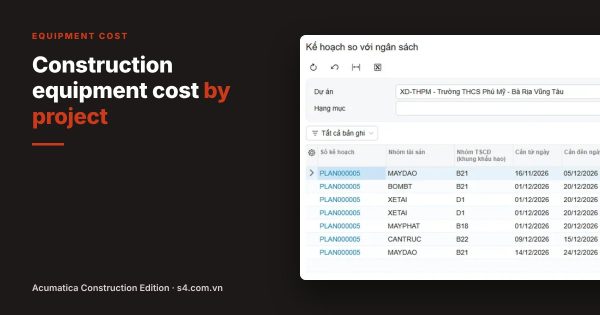
Acumatica covers these industries mainly through its own editions, while Business Central covers them through Premium functionality plus partner apps. Acumatica Construction Edition adds job costing, subcontracts, compliance tracking and project accounting. Manufacturing Edition adds bills of material, production orders and MRP, with advanced planning available depending on licensed modules. Distribution Edition focuses on inventory, warehouse and order management. Business Central Premium includes manufacturing and service management, and many companies add industry apps from Microsoft AppSource for deeper needs.
A packaged edition means one vendor roadmap and one upgrade cycle; each partner app adds a vendor and an upgrade dependency. If you are in construction, read what Acumatica Construction Edition includes (Vietnamese) before scoring the two options.
What does Vietnam localization require from either ERP?
Vietnam localization is where many comparisons are decided, and it depends as much on the partner as on the product. A mid-size or large Vietnamese company typically needs the following:
- Financial reporting: the VAS chart of accounts, financial statements under Circular 99 and the supporting ledgers auditors expect.
- E-invoice: issuing, adjusting and replacing invoices through an integration with a licensed provider.
- Payroll: timesheets, allowances, social insurance and personal income tax data prepared from configured rules.
- Language: Vietnamese or bilingual report layouts for staff, auditors and authorities.
For Acumatica, review the scope of the Acumatica localization package for Vietnam from S4 Consulting to see which of these items it covers for your edition. For Business Central, ask your partner whether each item is a Microsoft standard feature, a partner extension or custom development, who owns the code, and how it is maintained through Microsoft’s regular updates.
How do the partner ecosystems compare?
Business Central has a larger global partner and app ecosystem, while Acumatica has a smaller and more focused partner network with a marketplace of add-ons such as Velixo for Excel-based Acumatica reporting. Global size matters less than the local team: ask who will lead finance and localization, what support hours they offer in your time zone, and which parts of the solution they maintain themselves.
When does each ERP fit best?
Acumatica fits broad user access and a matching industry edition; Business Central fits Microsoft-centric firms with a stable full-user group.
Acumatica tends to fit when:
- Many employees across sites, warehouses or projects need to enter or approve transactions.
- Headcount is growing and you do not want license cost tied to each new user.
- A construction, manufacturing or distribution edition covers most of your processes without third-party apps.
Business Central tends to fit when:
- Your organization is standardized on Microsoft 365, Teams and Power BI.
- The number of full users is stable and many others only need Team Members access.
- Your partner can show a proven set of apps and localization for your industry in Vietnam.
Whichever way you lean, ask both partners to walk through the same five to eight business scenarios with your own sample data and to put the localization scope in writing. If NetSuite is also on your list, see the NetSuite vs Acumatica vs Business Central comparison, or talk to S4 Consulting about mapping your requirements to each option.
Frequently asked questions
Is Acumatica cheaper than Business Central?
It depends on your user profile. Acumatica cost follows resource and transaction usage, while Business Central cost grows with named users. Compare a five-year total cost.
Does Acumatica really allow unlimited users?
Yes. Acumatica licensing is based on resource and transaction usage rather than user count, so you can add users without buying user licenses, within the licensed resource level.
Can Business Central be localized for Vietnam?
Confirm VAS and Circular 99 reporting, e-invoice and payroll with your Business Central partner, including who maintains each item after updates.
Which ERP is better for construction companies in Vietnam?
Acumatica offers a dedicated Construction Edition. Business Central usually relies on partner apps for construction depth, so compare the specific apps proposed.